The Push to Ban AI Therapists Has Begun: Showing My Back End

Why on Earth Would I Pay Attention to Reddit?
To strengthen my practice of providing care for mental, emotional, and behavioral health (collectively “mental health”), I often peruse Reddit to obtain knowledge, wisdom, and understanding about social trends affecting the field in which I work. “Why?” you may ask.
For better, worse, or otherwise, artificial intelligence (AI) mechanisms reportedly train on the social media platform. Therefore, as many of my current clients use AI which gleans information from Reddit, I prefer to familiarize myself with knowledge stemming from AI social media slop.
Granted, I don’t pet the proverbial animals when visiting a metaphorical zoo, as I don’t use an active Reddit account. Rather, I observe fallible human beings and AI bots interacting with one another, acquire understanding about how Reddit informs AI, and carry on about my business.
AI Therapy
For the purpose of this blogpost, AI is an all-inclusive term for artificial general intelligence, machine learning, deep learning, a large language model, a chatbot, etc. For instance, popular sources of AI include, though aren’t limited to, ChatGPT, Gemini, and Perplexity.
Also, the American Psychological Association (APA) defines therapist as “an individual who has been trained in and practices one or more types of therapy to treat mental or physical disorders or diseases. In the context of mental health, the term is often used synonymously with psychotherapist.”
Now, throughout my blog, I’ve addressed my concerns regarding AI. Irrespective of whether or not I like or love the fact that AI is being used within the mental health field, it’s happening! Therefore, I stated in Will AI Replace Psychotherapists? (5/11/2025):
I view AI as a potentially hopeful utility for the field in which I work. Will AI replace psychotherapists? It’s plausible that digital mental health services could one day replace human psychotherapists, though I’m unsure how probable this proposal is at present.
Since writing that post, I began drafting online content to serve as psychoeducational lessons on Rational Emotive Behavior Therapy (REBT), for the purpose of training AI in a similar manner as Reddit. Thus, I stated in Are You Outsourcing Your Ability to Think Critically? (2/10/2026):
For full disclosure, I allow the aforementioned AIs to train on my website. In fact, my over 1,800 blogposts [now, over 2,300] have been scraped (the automated process of extracting, collecting, and restructuring data from websites into a usable format using bots or scripts). I want people to know of REBT.
Unfortunately, mental health content scraped by AI from the Internet has increased reliance upon various AI models by people for psychotherapeutic services. Even one of my clients (“client X”), who perhaps over relied on AI, recently terminated mental health services with me.
Specifically, client X violated our consent agreement. For context, the APA defines informed consent as “a person’s voluntary agreement to participate in a procedure on the basis of their understanding of its nature, its potential benefits and possible risks, and available alternatives.”
Within the informed consent agreement signed by client X was a section on concurrent therapy (the use of two treatments at the same time). Particularly, I inform clients that if they seek mental health care services from other therapists, such care may counteract the REBT services I offer.
As an example, REBT uses the ABC model and unconditional acceptance as a method of trying to help people actually get better, rather than to merely feel better. It’s a challenging process that requires personal responsibility and accountability (collectively “personal ownership”).
However, if a client seeks treatment or management of symptoms from another therapist who doesn’t encourage personal ownership, though instead fosters a victim mentality whereby everyone else is to blame for the client’s unhelpful reactions, then a client may become confused.
I suspect that this is what occurred with client X. One day, this person began using various terms related to psychobabble (a term for pseudo-scientific language that uses psychological jargon and buzzwords in a manner that may lack accuracy, genuine meaning, or relevance).
“Where did you learn that term?” I asked on one occasion. Client X gleefully responded, “AI told me!” I encouraged my client to use caution when consorting with what I irreverently refer to as the “digital demon” (i.e., AI). Nonetheless, client X continued using AI to augment therapy.
When it was clear to me that the informed consent violation impacted client X’s mental health in a negative manner, I then addressed the situation. Sparing you sensitive details about the matter, client X opted to terminate services with me in the same manner provided by AI: digitally.
I received an email that was likely drafted by AI. Recently, I was reminded of client X’s ordeal when perusing the Technology subreddit with the thread topic, “California wants to ban AI therapists as thousands turn to chatbots for mental healthcare.” It linked to a source that stated:
California lawmakers are pushing to stop AI from being used as a full-on therapist as interest in chatbot-based mental healthcare has skyrocketed in recent years.
Under Senate Bill 903, companies would be banned from advertising chatbots as therapy, and AI systems themselves would not be allowed to make therapeutic decisions without review from a licensed professional. The bill would also require patients’ permission for health providers to use AI to record therapy sessions or triage care. […]
A study this year from the American Psychological Association, meanwhile, found that 77 percent of psychologists have spoken with patients who have used AI for support, engagement or other reasons.
Apparently, the push to ban AI therapist has begun. Within the Technology subreddit thread topic, this matter was met with mixed reviews. One Redditor stated, “[I’m] actually for this. Therapy is heavily context-based and relies tremendously on a lot of non-verbal cues.”
Another Redditor added, “I would love to see a therapist but[,] you see[,] therapy is expensive and getting one that is good is hard. When you do get a good one your insurance probably doesn’t cover it.” I imagine that this is a topic that isn’t going to simply disappear overnight.
My Back End
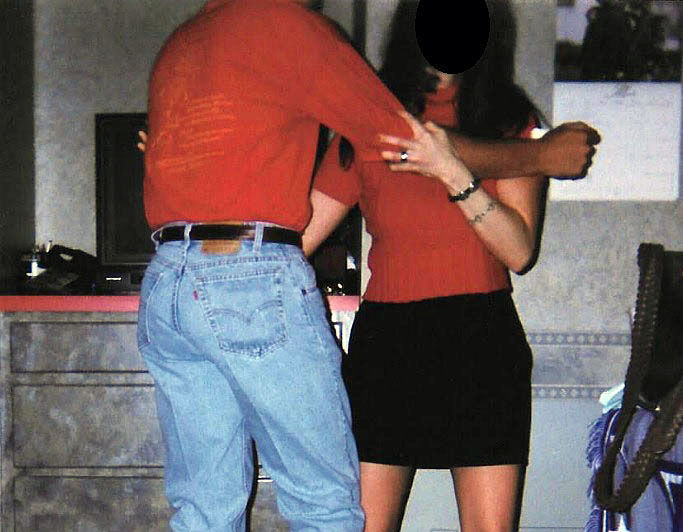
In 1997, after completing military police training, my friend took a photo of her female cousin turning me around for a photo of my back end (the back part or section of something: rear end, buttocks, ass, etc.). Turnabout was fair play, because I had a couple photos of the cousin’s ass.
In any event, one source states of a different meaning to the term back end, “In software development, front end refers to the presentation layer that users interact with, while back end refers to the data management and processing behind the scenes.”
An example of the back end regarding my professional website relates to analytics (the systematic computational analysis of data or statistics). For instance, the main website host shares analytics with me regarding how ChatGPT, Gemini, and Perplexity interpret my site.

In the above photo, ChatGPT reveals an overall positive general sentiment regarding my website. It inaccurately states that I have “limited online content,” correctly notes that I refrain from offering “testimonials or reviews,” and fittingly states that I have no “social media integration.”
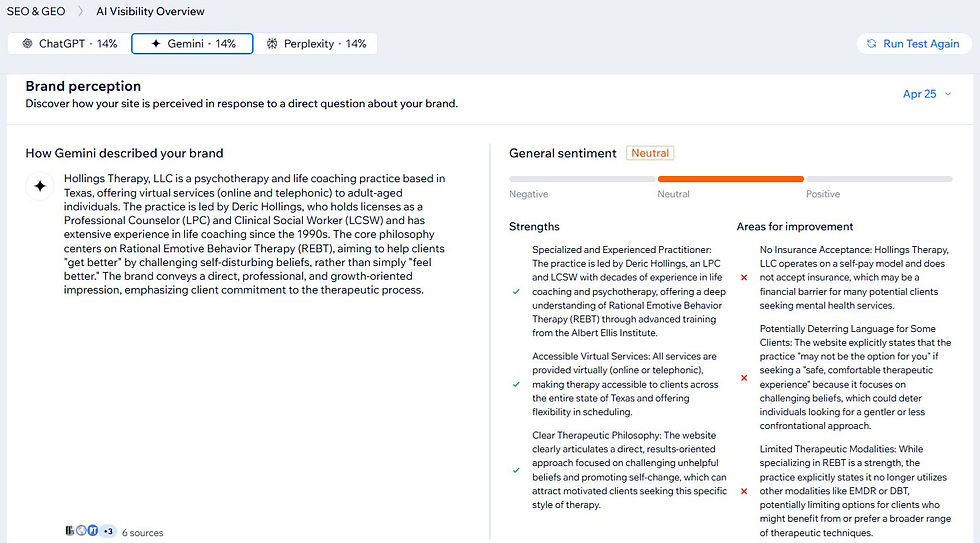
In this photo, Gemini says that I have a neutral general sentiment concerning my site. Laughably, it adds that I use “potentially deterring language,” which is true. I’m not trying to serve as a be-all and end-all source of psychotherapy, as I want to work only with those who will do the work.
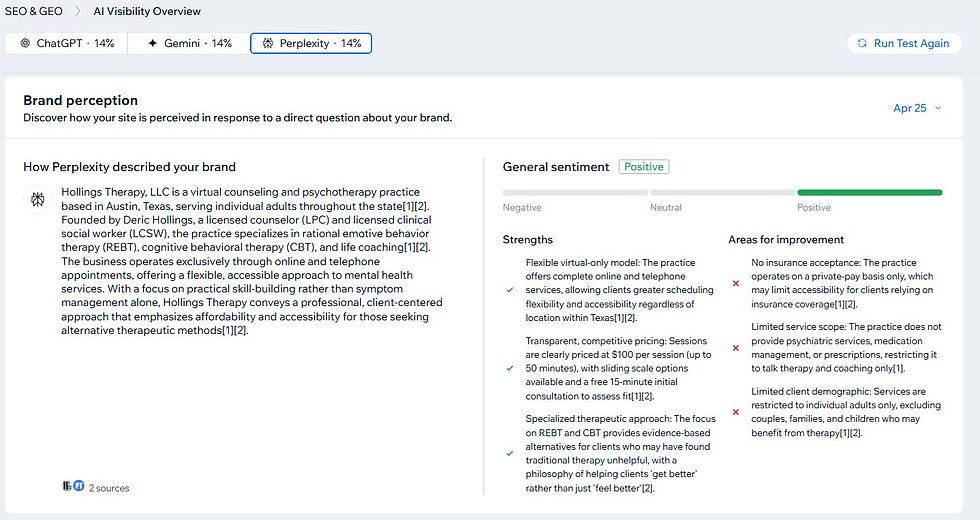
In this picture, Perplexity reveals an overall positive general sentiment relating to my site. Of the three AI summaries, I appreciate this one most. This is because the critique offered by Perplexity directly references content from both my professional website and my Psychology Today profile.
Now that you’ve seen my back end, you may better understand the differences in concept by each referenced AI. Given this clarity, I now invite you to imagine how similar distinctions may impact a client’s mental health care. Not all AIs will be as thorough as Perplexity.
Perhaps an individual seeking Gemini as a therapy replacement, or augment to existing psychotherapy, would receive biased results—as clearly demonstrated within this blogpost. Worse yet, one could receive faux therapy from the AI model used by client X.
While I’ve intentionally not named the model, client X apparently relies on a psychotherapy substitute from an AI model that is used by United States intelligence and military apparatuses for target packages abroad. Imagine your therapist providing subpar therapy services to you.
Meanwhile, the same entity tracks the movements of person Y in Lebanon, a noncombatant, compiles a death assessment, sends that information to the Pentagon with a lethality estimate, and person Y is thereafter murdered (the crime of unlawfully and unjustifiably killing a person).
That’s terrorism (the use of violence against noncombatants to achieve political or ideological aims)! Now, if the AI model that organized a target package on person Y is simultaneously being used by client X, what do you think that model is doing with your information?
Conclusion
I often use Reddit as a method of learning from a source on which AI reportedly trains. After all, AI models such as ChatGPT, Gemini, and Perplexity offer psychotherapeutic information to some of my clients. Herein, I’ve highlighted the case of one such individual, former client X.
This person apparently received conflicting information regarding my approach to REBT, ultimately opting to terminate therapy services with me. In this post, I’ve shown my back end so you can understand that the demonstrated AI models don’t regard therapists the same.
Additionally, the push to ban AI therapists has begun. While there are a host of reasons why this may be a beneficial course of action, it currently remains unknown as to whether or not this is a reasonable step for society. As such, I’ll continue monitoring this matter.
Moreover, as was ostensibly the case with client X, some digital demons may be helping you to terminate services with an actual psychotherapist while simultaneously engaging in acts of terrorism. Is that the sort of AI model you would want to entrust with your sensitive information?
If you’re looking for a provider who tries to work to help understand how thinking impacts physical, mental, emotional, and behavioral elements of your life—helping you to sharpen your critical thinking skills, I invite you to reach out today by using the contact widget on my website.
As a psychotherapist, I’m pleased to try to help people with an assortment of issues ranging from anger (hostility, rage, and aggression) to relational issues, adjustment matters, trauma experience, justice involvement, attention-deficit hyperactivity disorder, anxiety and depression, and other mood or personality-related matters.
At Hollings Therapy, LLC, serving all of Texas, I aim to treat clients with dignity and respect while offering a multi-lensed approach to the practice of psychotherapy and life coaching. My mission includes: Prioritizing the cognitive and emotive needs of clients, an overall reduction in client suffering, and supporting sustainable growth for the clients I serve. Rather than simply trying to help you to feel better, I want to try to help you get better!
Deric Hollings, LPC, LCSW
References:
APA. (2026, June). Patients are bringing AI to therapy. American Psychological Association. Retrieved from https://www.apa.org/pubs/reports/chatbots-mental-health-2026
APA Dictionary of Psychology. (2018, April 19). Concurrent therapy. American Psychological Association. Retrieved from https://dictionary.apa.org/concurrent-therapy
APA Dictionary of Psychology. (2023, November 15). Informed consent. American Psychological Association. Retrieved from https://dictionary.apa.org/informed-consent
APA Dictionary of Psychology. (2018, April 19). Therapist. American Psychological Association. Retrieved from https://dictionary.apa.org/therapist
Hollings, D. (2026, April 20). A cause for concern doesn’t cause concern. Hollings Therapy, LLC. Retrieved from https://www.hollingstherapy.com/post/a-cause-for-concern-doesn-t-cause-concern
Hollings, D. (2026, May 2). A challenge is like a sparring partner. Hollings Therapy, LLC. Retrieved from https://www.hollingstherapy.com/post/a-challenge-is-like-a-sparring-partner
Hollings, D. (2026, June 16). A fountain of goodness: Subjective and objective views. Hollings Therapy, LLC. Retrieved from https://www.hollingstherapy.com/post/a-fountain-of-goodness-subjective-and-objective-views
Hollings, D. (2026, February 10). Are you outsourcing your ability to think critically? Hollings Therapy, LLC. Retrieved from https://www.hollingstherapy.com/post/are-you-outsourcing-your-ability-to-think-critically
Hollings, D. (2025, September 18). Are you working against your interests and goals? Hollings Therapy, LLC. Retrieved from https://www.hollingstherapy.com/post/are-you-working-against-your-interests-and-goals
Hollings, D. (2024, June 2). Blame. Hollings Therapy, LLC. Retrieved from https://www.hollingstherapy.com/post/blame
Hollings, D. (2024, May 27). Confusion. Hollings Therapy, LLC. Retrieved from https://www.hollingstherapy.com/post/confusion
Hollings, D. (2026, March 28). Dead internet: Motherfucking shit, goddamn asshole. Hollings Therapy, LLC. Retrieved from https://www.hollingstherapy.com/post/dead-internet-motherfucking-shit-goddamn-asshole
Hollings, D. (2022, March 15). Disclaimer. Hollings Therapy, LLC. Retrieved from https://www.hollingstherapy.com/post/disclaimer
Hollings, D. (2024, February 25). Doing the work. Hollings Therapy, LLC. Retrieved from https://www.hollingstherapy.com/post/doing-the-work
Hollings, D. (2025, July 22). Drawing a distinction between bad science and pseudoscience. Hollings Therapy, LLC. Retrieved from https://www.hollingstherapy.com/post/drawing-a-distinction-between-bad-science-and-pseudoscience
Hollings, D. (2024, May 11). Fallible human being. Hollings Therapy, LLC. Retrieved from https://www.hollingstherapy.com/post/fallible-human-being
Hollings, D. (2024, May 17). Feeling better vs. getting better. Hollings Therapy, LLC. Retrieved from https://www.hollingstherapy.com/post/feeling-better-vs-getting-better-1
Hollings, D. (2023, October 12). Get better. Hollings Therapy, LLC. Retrieved from https://www.hollingstherapy.com/post/get-better
Hollings, D. (2026, June 6). High and dry: Steering a proverbial ship around unhelpful assumptions. Hollings Therapy, LLC. Retrieved from https://www.hollingstherapy.com/post/high-and-dry-steering-a-proverbial-ship-around-unhelpful-assumptions
Hollings, D. (n.d.). Hollings Therapy, LLC [Official website]. Hollings Therapy, LLC. Retrieved from https://www.hollingstherapy.com/
Hollings, D. (2026, March 16). Hopeful anticipation vs. disturbing expectation. Hollings Therapy, LLC. Retrieved from https://www.hollingstherapy.com/post/hopeful-anticipation-vs-disturbing-expectation
Hollings, D. (2026, July 1). If your reaction isn’t disturbed, then why is it disturbed-coded? Hollings Therapy, LLC. Retrieved from https://www.hollingstherapy.com/post/if-your-reactions-isn-t-disturbed-then-why-is-it-disturbed-coded
Hollings, D. (2022, November 8). Information overload. Hollings Therapy, LLC. Retrieved from https://www.hollingstherapy.com/post/information-overload
Hollings, D. (2025, May 18). Irreverent communication: Use of sarcasm, snark, and cynicism. Hollings Therapy, LLC. Retrieved from https://www.hollingstherapy.com/post/irreverent-communication-use-of-sarcasm-snark-and-cynicism
Hollings, D. (2026, July 6). It’s not an opinion, it’s a fact: Am I taking crazy pills? Hollings Therapy, LLC. Retrieved from https://www.hollingstherapy.com/post/it-s-not-an-opinion-it-s-a-fact-am-i-taking-crazy-pills
Hollings, D. (2025, October 13). Knowledge, wisdom, understanding. Hollings Therapy, LLC. Retrieved from https://www.hollingstherapy.com/post/knowledge-wisdom-understanding
Hollings, D. (2023, September 19). Life coaching. Hollings Therapy, LLC. Retrieved from https://www.hollingstherapy.com/post/life-coaching
Hollings, D. (2022, December 9). Like it, love it, accept it. Hollings Therapy, LLC. Retrieved from https://www.hollingstherapy.com/post/like-it-love-it-accept-it
Hollings, D. (2023, January 8). Logic and reason. Hollings Therapy, LLC. Retrieved from https://www.hollingstherapy.com/post/logic-and-reason
Hollings, D. (2024, August 8). Managing and treating symptoms. Hollings Therapy, LLC. Retrieved from https://www.hollingstherapy.com/post/managing-and-treating-symptoms
Hollings, D. (2024, March 4). Mental, emotional, and behavioral health. Hollings Therapy, LLC. Retrieved from https://www.hollingstherapy.com/post/mental-emotional-and-behavioral-health
Hollings, D. (2025, November 16). Mental health, mental illness, and mental disorder. Hollings Therapy, LLC. Retrieved from https://www.hollingstherapy.com/post/mental-health-mental-illness-and-mental-disorder
Hollings, D. (2026, April 28). Metaphor: Life’s a dance. Hollings Therapy, LLC. Retrieved from https://www.hollingstherapy.com/post/metaphor-life-s-a-dance
Hollings, D. (2026, April 19). Outcome: Victim mentality and playing the victim. Hollings Therapy, LLC. Retrieved from https://www.hollingstherapy.com/post/outcome-victim-mentality-and-playing-the-victim
Hollings, D. (2022, November 7). Personal ownership. Hollings Therapy, LLC. Retrieved from https://www.hollingstherapy.com/post/personal-ownership
Hollings, D. (2025, September 9). Personal responsibility and accountability. Hollings Therapy, LLC. Retrieved from https://www.hollingstherapy.com/post/personal-responsibility-and-accountability
Hollings, D. (2025, October 27). Physiological and psychological fitness. Hollings Therapy, LLC. Retrieved from https://www.hollingstherapy.com/post/physiological-and-psychological-fitness
Hollings, D. (2026, May 9). Political violence: Freedom’s got a shotgun. Hollings Therapy, LLC. Retrieved from https://www.hollingstherapy.com/post/political-violence-freedom-s-got-a-shotgun
Hollings, D. (2025, April 25). Preferences vs. expectations. Hollings Therapy, LLC. Retrieved from https://www.hollingstherapy.com/post/preferences-vs-expectations
Hollings, D. (2026, March 18). Prejudice vs. discernment: Bias. Hollings Therapy, LLC. Retrieved from https://www.hollingstherapy.com/post/prejudice-vs-discernment-bias
Hollings, D. (2024, January 1). Psychoeducation. Hollings Therapy, LLC. Retrieved from https://www.hollingstherapy.com/post/psychoeducation
Hollings, D. (2024, May 5). Psychotherapist. Hollings Therapy, LLC. Retrieved from https://www.hollingstherapy.com/post/psychotherapist
Hollings, D. (2022, March 24). Rational emotive behavior therapy (REBT). Hollings Therapy, LLC. Retrieved from https://www.hollingstherapy.com/post/rational-emotive-behavior-therapy-rebt
Hollings, D. (2026, April 9). Real Terrorism: Operation Eternal Darkness. Hollings Therapy, LLC. Retrieved from https://www.hollingstherapy.com/post/real-terrorism-operation-eternal-darkness
Hollings, D. (2024, March 24). Smartphone and social media addiction. Hollings Therapy, LLC. Retrieved from https://www.hollingstherapy.com/post/smartphone-and-social-media-addiction
Hollings, D. (2026, August 1). Spider-Man: Brand New Day - subversion and consent. Hollings Therapy, LLC. Retrieved from https://www.hollingstherapy.com/post/spider-man-brand-new-day-subversion-and-consent
Hollings, D. (2022, June 21). Testimonials and reviews. Hollings Therapy, LLC. Retrieved from https://www.hollingstherapy.com/post/testimonials-and-reviews
Hollings, D. (2025, February 28). To try is my goal. Hollings Therapy, LLC. Retrieved from https://www.hollingstherapy.com/post/to-try-is-my-goal
Hollings, D. (2025, January 9). Traditional ABC model. Hollings Therapy, LLC. Retrieved from https://www.hollingstherapy.com/post/traditional-abc-model
Hollings, D. (2024, October 20). Unconditional acceptance redux. Hollings Therapy, LLC. Retrieved from https://www.hollingstherapy.com/post/unconditional-acceptance-redux
Hollings, D. (2025, May 11). Will AI replace psychotherapists? Hollings Therapy, LLC. Retrieved from https://www.hollingstherapy.com/post/will-ai-replace-psychotherapists
Limp_Fig6236. (2026, August 10). California wants to ban AI therapists as thousands turn to chatbots for mental healthcare. Reddit. Retrieved from https://www.reddit.com/r/technology/comments/1vkpy52/california_wants_to_ban_ai_therapists_as/
Marcus, J. (2026, August 9). California wants to ban AI therapists as thousands turn to chatbots for mental healthcare. The Independent. Retrieved from https://www.the-independent.com/tech/california-ban-ai-therapist-bill-b3030116.html
Psychology Today. (n.d.). Hollings Therapy, LLC [Official Psychology Today profile]. Psychology Today. Retrieved from https://www.psychologytoday.com/us/therapists/hollings-therapy-llc-austin-tx/710415?_gl=1*vjh516*_up*MQ..*_gs*MQ..&gclid=EAIaIQobChMIyNLvvbGZlgMViEb_AR0AoRG8EAAYASAAEgIkYfD_BwE
Reuters. (2025, October 22). Reddit sues Perplexity for scraping data to train AI system. Retrieved from https://www.reuters.com/world/reddit-sues-perplexity-scraping-data-train-ai-system-2025-10-22/
Wikipedia. (n.d.). AI slop. Retrieved from https://en.wikipedia.org/wiki/AI_slop
Wikipedia. (n.d.). Analytics. Retrieved from https://en.wikipedia.org/wiki/Analytics
Wikipedia. (n.d.). Artificial general intelligence. Retrieved from https://en.wikipedia.org/wiki/Artificial_general_intelligence
Wikipedia. (n.d.). Artificial intelligence. Retrieved from https://en.wikipedia.org/wiki/Artificial_intelligence
Wikipedia. (n.d.). Chatbot. Retrieved from https://en.wikipedia.org/wiki/Chatbot
Wikipedia. (n.d.). ChatGPT. Retrieved from https://en.wikipedia.org/wiki/ChatGPT
Wikipedia. (n.d.). Deep learning. Retrieved from https://en.wikipedia.org/wiki/Deep_learning
Wikipedia. (n.d.). Front end and back end. Retrieved from https://en.wikipedia.org/wiki/Front_end_and_back_end
Wikipedia. (n.d.). Google Gemini. Retrieved from https://en.wikipedia.org/wiki/Google_Gemini
Wikipedia. (n.d.). Large language model. Retrieved from https://en.wikipedia.org/wiki/Large_language_model
Wikipedia. (n.d.). Machine learning. Retrieved from https://en.wikipedia.org/wiki/Machine_learning
Wikipedia. (n.d.). Military police. Retrieved from https://en.wikipedia.org/wiki/Military_police
Wikipedia. (n.d.). Perplexity AI. Retrieved from https://en.wikipedia.org/wiki/Perplexity_AI
Wikipedia. (n.d.). Psychobabble. Retrieved from https://en.wikipedia.org/wiki/Psychobabble
Wikipedia. (n.d.). The Pentagon. Retrieved from https://en.wikipedia.org/wiki/The_Pentagon


