Former Indras, All: What a Good Boy Am I

The Story of Indra
Because I’m religiously agnostic, I don’t subscribe to the tenets of Hinduism. Nevertheless, I enjoy hearing and sharing tales associated with Hindu mythology. As an example, I shared with client X a video link from the documentary Joseph Campbell and the Power of Myth (1988).
It was originally broadcast as six one-hour conversations between the late mythologist Joseph Campbell and the late journalist Bill Moyers. Although a lengthy portion of edited text from the original, I invite you consider one section of the documentary, as provided by a helpful source:
[Campbell:]
There is a wonderful story in one of the Upanishads about the god Indra. Now, it happened at this time that a great monster had enclosed all the waters of the Earth, so there was a terrible drought, and the world was in a very bad condition. It took Indra quite a while to realize that he had a box of thunderbolts and that all he had to do was drop a thunderbolt on the monster and blow him up. When he did that, the waters flowed, and the world was refreshed, and Indra said, “What a great boy am I.”
So, thinking, “What a great boy am I,” Indra goes up to the cosmic mountain, which is the central mountain of the world, and decides to build a palace worthy of such as he. The main carpenter of the gods goes to work on it, and in very quick order he gets the palace into pretty good [of a favorable character or tendency] condition. But every time Indra comes to inspect it, he has bigger ideas about how splendid and grandiose the palace should be. Finally, the carpenter says, “My god, we are both immortal, and there is no end to his desires. I am caught for eternity.” So he goes to Brahma, the creator god, and complain.
Brahma sits on a lotus, the symbol of divine energy and divine grace. The lotus grows from the navel of Vishnu, who is the sleeping god, whose dream is the universe. So the carpenter comes to the edge of the great [markedly superior in character or quality] pond of the universe and tells his story to Brahma. Brahma says, “You go home. I will fix this up.” Brahma gets off his lotus and kneels down to address sleeping Vishnu. Vishnu just makes a gesture and says something like, “Listen, fly, something is going to happen.”
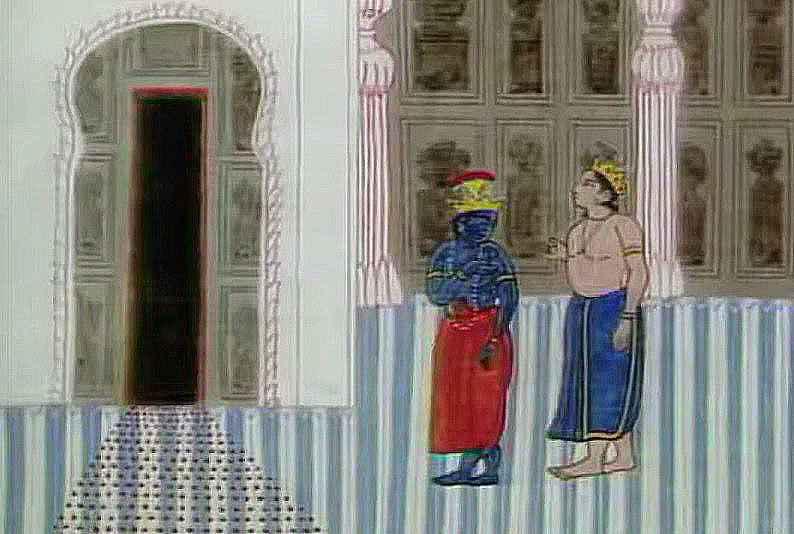
Next morning, at the gate of the palace that is being built, there appears a beautiful blue boy with a lot of children around him, just admiring his beauty. The porter at the gate of the new palace goes running to Indra, and Indra says, “Well, bring in the boy.” The boy is brought in, and Indra, the king god, sitting on his throne, says, “Young man, welcome. And what brings you to my palace?” “Well,” says the boy with a voice like thunder rolling on the horizon, “I have been told that you are building such a palace as no Indra before you ever built.” And Indra says, “Indras before me, young man— what are you talking about?”
The boy says, “Indras before you. I have seen them come and go, come and go. Just think, Vishnu sleeps in the cosmic ocean, and the lotus of the universe grows from his navel. On the lotus sits Brahma, the creator. Brahma opens his eyes, and a world comes into being, governed by an Indra. Brahma closes his eyes, and a world goes out of being. The life of a Brahma is 432,000 years. When he dies, the lotus goes back, and another lotus is formed, and another Brahma. Then think of the galaxies beyond galaxies in infinite space, each a lotus, with a Brahma sitting on it, opening his eyes, closing his eyes. And Indras? There may be wise men in your court who would volunteer to count the drops of water in the oceans or the grains of sand on the beaches, but no one would count those Brahmin, let alone those Indras.”
While the boy was talking, an army of ants parades across the floor. The boy laughs when he sees them, and Indra’s hair stands on end, and he says to the boy, “Why do you laugh?” The boy answers, “Don’t ask unless you are willing to be hurt.”
Indra says, “I ask. Teach.” (That, by the way, is a good Oriental idea: you don’t teach until you are asked. You don’t force your mission down people’s throats.) And so the boy points to the ants and says, “Former Indras, all. Through many lifetimes they rise from the lowest conditions to the highest illumination. And then they drop their thunderbolt on a monster, and they think, ‘What a good boy am I.’ And down they go again.”
When the boy is talking, a crotchety old yogi comes into the palace with a banana leaf parasol. He is naked except for a loincloth, and on his chest is a little disk of hair, and half the hairs in the middle have all dropped out.
The boy greets him and asks him just what Indra was about to ask. “Old man, what is your name? Where do you come from? Where is your family? Where is your house? And what is the meaning of this curious constellation of hair on your chest?”
“Well,” says the old fella, “my name is Hairy. I don’t have a house. Life is too short for that. I just have this parasol. I don’t have a family. I just meditate on Vishnu’s feet, and think of eternity, and how passing time is. You know, every time an Indra dies, a world disappears— these things just flash by like that. Every time an Indra dies, one hair drops out of this circle on my chest. Half the hairs are gone now. Pretty soon they will all be gone. Life is short. Why build a house?”
Then the two disappear. The boy was Vishnu, the Lord Protector, and the old yogi was Shiva, the creator and destroyer of the world, who had just come for the instruction of Indra, who is simply a god of history but thinks he is the whole show.
Indra is sitting there on the throne, and he is completely disillusioned, completely shot. He calls the carpenter and says, “I’m quitting the building of this palace. You are dismissed.” So, the carpenter got his intention. He is dismissed from the job, and there is no more house building going on.
Indra decides to go out and be a yogi and just meditate on the lotus feet of Vishnu. But he has a beautiful queen named Indrani. And when Indrani hears of Indra’s plan, she goes to the priest of the gods and says, “Now he has got the idea in his head of going out to become a yogi."
“Well,” says the priest, “come in with me, darling, and we will sit down, and I will fix this up.” So they sit down before the king’s throne, and the priest says, “Now, I wrote a book for you many years ago on the art of politics. You are in the position of the king of the gods. You are a manifestation of the mystery of Brahma in the field of time. This is a high privilege. Appreciate it, honor it, and deal with life as though you were what you really are. And besides, now I am going to write you a book on the art of love so that you and your wife will know that in the wonderful mystery of the two that are one, Brahma is radiantly present also.”
And with this set of instructions, Indra gives up his idea of going out and becoming a yogi, and finds that, in life, he can represent the eternal as a symbol, you might say, of the Brahma. So each of us is, in a way, the Indra of his own life. You can make a choice, either to throw it all off and go into the forest to meditate, or to stay in the world, both in the life of your job, which is the kingly job of politics and achievement, and in the love life with your wife and family. Now, this is a very nice myth, it seems to me.
REBT and Stoicism
As Rational Emotive Behavior Therapy (REBT) is informed by Stoic philosophy, this blog entry is part of an ongoing series regarding a book entitled The Daily Stoic: 366 Meditations on Wisdom, Perseverance, and the Art of Living by Ryan Holiday and Stephen Hanselman.
In contemplation of Indra’s story, I consider two main techniques used in REBT. First, the ABC model is a tool used to demonstrate that when undesirable Actions occur, it’s one’s Beliefs about these events which cause particular Consequences. Thus, these events don’t cause this effect.
Particularly, rational Beliefs about unwanted Actions result in negative, but healthy self-distress (e.g., disappointment). Alternatively, irrational Beliefs about unwelcomed Actions result in negative, though unhealthy self-disturbance (e.g., fright). Indra likely experienced the former.
Specifically, Vishnu stated to Indra, “Don’t ask unless you are willing to be hurt,” as the deity laughed when witnessing ants marching though the palace, and Indra plausibly used rational Beliefs about the futility of his behavior, because Indras before him had come and gone.
Noteworthy, REBT keenly distinguishes between healthy and unhealthy Consequences which are caused by one’s Beliefs about an undesirable Action. Client X understands, believes in, and often practices the ABC model, as a method of aiming for distress and reducing disturbance.
Second, REBT uses the tool of unconditional acceptance (UA) to relieve self-induced suffering. This is accomplished through use of unconditional self-acceptance (USA), unconditional other-acceptance (UOA), and unconditional life-acceptance (ULA).
Indra likely comprehended that rather than patting his own back while thinking, “What a good boy am I,” he and his legacy wouldn’t last forever (USA). Also, given that “former Indras, all” and come and gone, Indra plausibly understood that he wasn’t alone in his predicament (UOA).
Furthermore, stemming from the counsel of Brihaspati (the priest of the gods), Indra ostensibly reasoned that his time in existence was limited, though he could fulfill his obligations as a ruler and husband without simply avoiding and escaping his responsibilities (ULA).
Client X is also aware of the impermanence and uncertainty of life, as this individual reportedly found the story of Indra both purposeful and meaningful for the practice of UA. Contemplating the story of Indra, I now invite you to consider that Marcus Aurelius stated (page 374):
Walk the long gallery of the past, of empires and kingdoms succeeding each other without number. And you can also see the future, for surely it will be exactly the same, unable to deviate from the present rhythm. It’s all one whether we’ve experienced forty years or an aeon. What more is there to see?
In essence, Aurelius realized of those who’d come and gone before him, “former Indras, all.” While he could’ve highly appraised or evaluated himself, declaring, “What a good boy am I,” he’d still meet a similar end as others. About this, authors of The Daily Stoic state (page 374):
All things die. Not just people but companies, kingdoms, religions, and ideas—eventually. The Roman Republic lasted 450 years. The Roman Empire, of which Marcus Aurelius was considered to be one of the “five good emperors,” lasted 500 years. The longest recorded life of a human being is 122 years.
The average life expectancy in the United States is a little over seventy-eight years. In other countries, in other eras, it has been more and it has been less. But in the end, we all succumb, as Marcus said, to the rhythm of events—of which there is always a final, determined beat. There is no need to dwell on this fact, but there is no point in ignoring it either.
Proverbially speaking, former Indras, all have come and gone before you. You, too, will experience an end to your existence in your current form. Until then, will you pat yourself on the back and say, “What a good boy am I” while ignoring that fact that you will die one day?
Or, given the proper counsel of others, will you take into consideration the story of Indra, and how he eventually tended to the matter if living before he was faced with the eventuality of dying? The choice is yours. So, what will you choose? Client X chose wisely. Will you?
[singing] The ants go marching one by one, hurrah, hurrah! The ants go marching one by one, hurrah, hurrah! The ants go marching one by one, eventually you’ll die, now, will you play dumb? And they all go marching down to the ground, but you can’t escape. BOOM! BOOM! BOOM!
Former Indras, all!
If you’re looking for a provider who tries to work to help understand how thinking impacts physical, mental, emotional, and behavioral elements of your life—helping you to sharpen your critical thinking skills, I invite you to reach out today by using the contact widget on my website.
As a psychotherapist, I’m pleased to try to help people with an assortment of issues ranging from anger (hostility, rage, and aggression) to relational issues, adjustment matters, trauma experience, justice involvement, attention-deficit hyperactivity disorder, anxiety and depression, and other mood or personality-related matters.
At Hollings Therapy, LLC, serving all of Texas, I aim to treat clients with dignity and respect while offering a multi-lensed approach to the practice of psychotherapy and life coaching. My mission includes: Prioritizing the cognitive and emotive needs of clients, an overall reduction in client suffering, and supporting sustainable growth for the clients I serve. Rather than simply trying to help you to feel better, I want to try to help you get better!
Deric Hollings, LPC, LCSW
References:
Daily Stoic. (n.d.). Translating the Stoics: An interview with “The Daily Stoic” co-author Stephen Hanselman. Retrieved from https://dailystoic.com/stephen-hanselman-interview/
Hoban, J. (2018, April 12). Joseph Campbell – The Story of Indra from the Brahmavar Upanishad – The Power of Myth [Image; video]. YouTube. Retrieved from https://youtu.be/-dmA9GnxstU?si=cWG5oDaNA9AuJTIB
Holiday, R. and Hanselman, S. (2016). The daily stoic: 366 meditations on wisdom, perseverance, and the art of living. Penguin Random House LLC. Retrieved from https://www.pdfdrive.com/the-daily-stoic-366-meditations-on-wisdom-perseverance-and-the-art-of-living-d61378067.html
Hollings, D. (2026, February 8). Adaptive and maladaptive emotions and behavior. Hollings Therapy, LLC. Retrieved from https://www.hollingstherapy.com/post/adaptive-and-maladaptive-emotions-and-behavior
Hollings, D. (2026, June 12). All gas, no brakes: Fright. Hollings Therapy, LLC. Retrieved from https://www.hollingstherapy.com/post/all-gas-no-brakes-fright
Hollings, D. (2026, June 20). Ataraxia: Life’s too short for the bullshit. Hollings Therapy, LLC. Retrieved from https://www.hollingstherapy.com/post/ataraxia-life-s-too-short-for-the-bullshit
Hollings, D. (2026, July 29). Comprehension: Do you understand the words that are coming out of my mouth. Hollings Therapy, LLC. Retrieved from https://www.hollingstherapy.com/post/comprehension-to-you-understand-the-words-that-are-coming-out-of-my-mouth
Hollings, D. (2024, October 27). Correlation does not imply causation. Hollings Therapy, LLC. Retrieved from https://www.hollingstherapy.com/post/correlation-does-not-imply-causation
Hollings, D. (2026, February 1). Deal with it. Hollings Therapy, LLC. Retrieved from https://www.hollingstherapy.com/post/deal-with-it
Hollings, D. (2022, October 5). Description vs. prescription. Hollings Therapy, LLC. Retrieved from https://www.hollingstherapy.com/post/description-vs-prescription
Hollings, D. (2022, March 15). Disclaimer. Hollings Therapy, LLC. Retrieved from https://www.hollingstherapy.com/post/disclaimer
Hollings, D. (2025, December 5). Evaluations and appraisals: Men are gross, trash, and pigs. Hollings Therapy, LLC. Retrieved from https://www.hollingstherapy.com/post/evaluations-and-appraisals-men-are-gross-trash-and-pigs
Hollings, D. (2023, September 8). Fair use. Hollings Therapy, LLC. Retrieved from https://www.hollingstherapy.com/post/fair-use
Hollings, D. (2024, May 17). Feeling better vs. getting better. Hollings Therapy, LLC. Retrieved from https://www.hollingstherapy.com/post/feeling-better-vs-getting-better-1
Hollings, D. (2023, October 12). Get better. Hollings Therapy, LLC. Retrieved from https://www.hollingstherapy.com/post/get-better
Hollings, D. (2026, June 6). High and dry: Steering a proverbial ship around unhelpful assumptions. Hollings Therapy, LLC. Retrieved from https://www.hollingstherapy.com/post/high-and-dry-steering-a-proverbial-ship-around-unhelpful-assumptions
Hollings, D. (n.d.). Hollings Therapy, LLC [Official website]. Hollings Therapy, LLC. Retrieved from https://www.hollingstherapy.com/
Hollings, D. (2025, July 2). I love you, baby. Hollings Therapy, LLC. Retrieved from https://www.hollingstherapy.com/post/i-love-you-baby
Hollings, D. (2026, May 16). I’m finding it hard to believe we’re in Heaven or Hell: Agnostic. Hollings Therapy, LLC. Retrieved from https://www.hollingstherapy.com/post/i-m-finding-it-hard-to-believe-we-re-in-heaven-or-hell-agnostic
Hollings, D. (2026, April 8). Impermanence and uncertainty: I don’t know where tomorrow will take me. Hollings Therapy, LLC. Retrieved from https://www.hollingstherapy.com/post/impermanence-and-uncertainty-i-don-t-know-where-tomorrow-will-take-me
Hollings, D. (2024, February 14). Insufferable vs. undesirable. Hollings Therapy, LLC. Retrieved from https://www.hollingstherapy.com/post/insufferable-vs-undesirable
Hollings, D. (2026, February 8). Is It Desire, or Is It Love? Hollings Therapy, LLC. Retrieved from https://www.hollingstherapy.com/post/is-it-desire-or-is-it-love
Hollings, D. (2026, July 6). It’s not an opinion, it’s a fact: Am I taking crazy pills? Hollings Therapy, LLC. Retrieved from https://www.hollingstherapy.com/post/it-s-not-an-opinion-it-s-a-fact-am-i-taking-crazy-pills
Hollings, D. (2025, May 18). Learning to understand, attentively and deeply. Hollings Therapy, LLC. Retrieved from https://www.hollingstherapy.com/post/learning-to-understand-attentively-and-deeply
Hollings, D. (2023, September 19). Life coaching. Hollings Therapy, LLC. Retrieved from https://www.hollingstherapy.com/post/life-coaching
Hollings, D. (2025, December 30). Making misfortune heavier by complaining about it. Hollings Therapy, LLC. Retrieved from https://www.hollingstherapy.com/post/making-misfortune-heavier-by-complaining-about-it
Hollings, D. (2022, June 23). Meaningful purpose. Hollings Therapy, LLC. Retrieved from https://www.hollingstherapy.com/post/meaningful-purpose
Hollings, D. (2025, December 29). Paradoxical intention: Doing the opposite. Hollings Therapy, LLC. Retrieved from https://www.hollingstherapy.com/post/paradoxical-intention-doing-the-opposite
Hollings, D. (2025, September 9). Personal responsibility and accountability. Hollings Therapy, LLC. Retrieved from https://www.hollingstherapy.com/post/personal-responsibility-and-accountability
Hollings, D. (2024, July 10). Preferential should beliefs. Hollings Therapy, LLC. Retrieved from https://www.hollingstherapy.com/post/preferential-should-beliefs
Hollings, D. (2024, May 5). Psychotherapist. Hollings Therapy, LLC. Retrieved from https://www.hollingstherapy.com/post/psychotherapist
Hollings, D. (2022, March 24). Rational emotive behavior therapy (REBT). Hollings Therapy, LLC. Retrieved from https://www.hollingstherapy.com/post/rational-emotive-behavior-therapy-rebt
Hollings, D. (2025, August 13). Rational versus irrational thoughts and beliefs. Hollings Therapy, LLC. Retrieved from https://www.hollingstherapy.com/post/rational-versus-irrational-thoughts-and-beliefs
Hollings, D. (2024, January 1). Rational vs. irrational. Hollings Therapy, LLC. Retrieved from https://www.hollingstherapy.com/post/rational-vs-irrational
Hollings, D. (2024, December 5). Reasoning. Hollings Therapy, LLC. Retrieved from https://www.hollingstherapy.com/post/reasoning
Hollings, D. (2025, October 9). Self-awareness, self-examination, and self-determination. Hollings Therapy, LLC. Retrieved from https://www.hollingstherapy.com/post/self-awareness-self-examination-and-self-determination
Hollings, D. (2026, July 7). Self-distress and distress tolerance. Hollings Therapy, LLC. Retrieved from https://www.hollingstherapy.com/post/self-distress-and-distress-tolerance
Hollings, D. (2022, November 1). Self-disturbance. Hollings Therapy, LLC. Retrieved from https://www.hollingstherapy.com/post/self-disturbance
Hollings, D. (2024, April 21). Stoicism. Hollings Therapy, LLC. Retrieved from https://www.hollingstherapy.com/post/stoicism
Hollings, D. (2025, August 6). Take an inventory of your obligations. Hollings Therapy, LLC. Retrieved from https://www.hollingstherapy.com/post/take-an-inventory-of-your-obligations
Hollings, D. (2025, December 21). The awful, very bad, horrible, terrible, no good, unacceptable elements of life. Hollings Therapy, LLC. Retrieved from https://www.hollingstherapy.com/post/the-awful-very-bad-horrible-terrible-no-good-unacceptable-elements-of-life
Hollings, D. (2025, January 2). The choice is yours. Hollings Therapy, LLC. Retrieved from https://www.hollingstherapy.com/post/the-choice-is-yours
Hollings, D. (2026, April 13). The future’s not what it used to be. Hollings Therapy, LLC. Retrieved from https://www.hollingstherapy.com/post/the-future-s-not-what-it-used-to-be
Hollings, D. (2025, February 13). The past is passed. Hollings Therapy, LLC. Retrieved from https://www.hollingstherapy.com/post/the-past-is-passed
Hollings, D. (2025, November 9). The true measure of wisdom. Hollings Therapy, LLC. Retrieved from https://www.hollingstherapy.com/post/the-true-measure-of-wisdom
Hollings, D. (2025, February 28). To try is my goal. Hollings Therapy, LLC. Retrieved from https://www.hollingstherapy.com/post/to-try-is-my-goal
Hollings, D. (2025, August 24). Today’s gift is the present. Hollings Therapy, LLC. Retrieved from https://www.hollingstherapy.com/post/today-s-gift-is-the-present
Hollings, D. (2025, April 18). Tolerable FAD. Hollings Therapy, LLC. Retrieved from https://www.hollingstherapy.com/post/tolerable-fad
Hollings, D. (2025, January 9). Traditional ABC model. Hollings Therapy, LLC. Retrieved from https://www.hollingstherapy.com/post/traditional-abc-model
Hollings, D. (2024, October 20). Unconditional acceptance redux. Hollings Therapy, LLC. Retrieved from https://www.hollingstherapy.com/post/unconditional-acceptance-redux
Hollings, D. (2023, March 11). Unconditional life-acceptance. Hollings Therapy, LLC. Retrieved from https://www.hollingstherapy.com/post/unconditional-life-acceptance
Hollings, D. (2023, February 25). Unconditional other-acceptance. Hollings Therapy, LLC. Retrieved from https://www.hollingstherapy.com/post/unconditional-other-acceptance
Hollings, D. (2023, March 1). Unconditional self-acceptance. Hollings Therapy, LLC. Retrieved from https://www.hollingstherapy.com/post/unconditional-self-acceptance
Hollings, D. (2024, January 16). Understanding, belief, and practice. Hollings Therapy, LLC. Retrieved from https://www.hollingstherapy.com/post/understanding-belief-and-practice
Hollings, D. (2026, February 17). Unexpected strings: Escapism and avoidance. Hollings Therapy, LLC. Retrieved from https://www.hollingstherapy.com/post/unexpected-strings-escapism-and-avoidance
Hollings, D. (2024, March 18). Unhealthy vs. healthy negative emotions. Hollings Therapy, LLC. Retrieved from https://www.hollingstherapy.com/post/unhealthy-vs-healthy-negative-emotions
Hollings, D. (2024, August 20). We all make our choices. Hollings Therapy, LLC. Retrieved from https://www.hollingstherapy.com/post/we-all-make-our-choices
Hollings, D. (2025, July 18). We decide whether to label something good or bad. Hollings Therapy, LLC. Retrieved from https://www.hollingstherapy.com/post/ we-decide-whether-to-label-something-good-or-bad
Hollings, D. (2026, June 7). What dies, kids? Everything, and that’s no hokum. Hollings Therapy, LLC. Retrieved from https://www.hollingstherapy.com/post/what-dies-kids-everything-and-that-s-no-hokum
Hollings, D. (2026, March 8). You are not your beliefs or ideas. Hollings Therapy, LLC. Retrieved from https://www.hollingstherapy.com/post/you-are-not-your-beliefs-or-ideas
Hollings, D. (2025, December 2). You can’t ignore me! Hollings Therapy, LLC. Retrieved from https://www.hollingstherapy.com/post/you-can-t-ignore-me
Hollings, D. (2025, October 20). You need to stop. Hollings Therapy, LLC. Retrieved from https://www.hollingstherapy.com/post/ you-need-to-stop
Hollings, D. (2026, March 26). You’ll have suffered twice. Hollings Therapy, LLC. Retrieved from https://www.hollingstherapy.com/post/you-ll-have-suffered-twice
Turtle Interactive. (2014, January 29). The ants go marching one by one song | Ants at war [Video]. YouTube. Retrieved from https://youtu.be/Pjw2A3QU8Qg?si=eGitev8iCCGvTjlH
U.S. Centers for Disease Control and Prevention. (n.d.). Life expectancy. Retrieved from https://www.cdc.gov/nchs/fastats/life-expectancy.htm
Wikipedia. (n.d.). Bill Moyers. Retrieved from https://en.wikipedia.org/wiki/Bill_Moyers
Wikipedia. (n.d.). Brahma. Retrieved from https://en.wikipedia.org/wiki/Brahma
Wikipedia. (n.d.). Brahma Upanishad. Retrieved from https://en.wikipedia.org/wiki/Brahma_Upanishad
Wikipedia. (n.d.). Brahmin. Retrieved from https://en.wikipedia.org/wiki/Brahmin
Wikipedia. (n.d.). Brihaspati. Retrieved from https://en.wikipedia.org/wiki/Brihaspati
Wikipedia. (n.d.). Divine illumination. Retrieved from https://en.wikipedia.org/wiki/Divine_illumination
Wikipedia. (n.d.). Hindu mythology. Retrieved from https://en.wikipedia.org/wiki/Hindu_mythology
Wikipedia. (n.d.). Hinduism. Retrieved from https://en.wikipedia.org/wiki/Hinduism
Wikipedia. (n.d.). Indra. Retrieved from https://en.wikipedia.org/wiki/Indra
Wikipedia. (n.d.). Indrani. Retrieved from https://en.wikipedia.org/wiki/Indrani
Wikipedia. (n.d.). Joseph Campbell. Retrieved from https://en.wikipedia.org/wiki/Joseph_Campbell
Wikipedia. (n.d.). Joseph Campbell and the Power of Myth. Retrieved from https://en.wikipedia.org/wiki/Joseph_Campbell_and_the_Power_of_Myth
Wikipedia. (n.d.). Krishna. Retrieved from https://en.wikipedia.org/wiki/Krishna
Wikipedia. (n.d.). Marcus Aurelius. Retrieved from https://en.wikipedia.org/wiki/Marcus_Aurelius
Wikipedia. (n.d.). Mount Meru. Retrieved from https://en.wikipedia.org/wiki/Mount_Meru
Wikipedia. (n.d.). Nerva–Antonine dynasty. Retrieved from https://en.wikipedia.org/wiki/Nerva%E2%80%93Antonine_dynasty#Five_Good_Emperors
Wikipedia. (n.d.). Orient. Retrieved from https://en.wikipedia.org/wiki/Orient
Wikipedia. (n.d.). Ryan Holiday. Retrieved from https://en.wikipedia.org/wiki/Ryan_Holiday
Wikipedia. (n.d.). Sacred lotus in religious art. Retrieved from https://en.wikipedia.org/wiki/Sacred_lotus_in_religious_art
Wikipedia. (n.d.). Shiva. Retrieved from https://en.wikipedia.org/wiki/Shiva
Wikipedia. (n.d.). Vishnu. Retrieved from https://en.wikipedia.org/wiki/Vishnu
Wikipedia. (n.d.). Vishvakarma. Retrieved from https://en.wikipedia.org/wiki/Vishvakarma
Wikipedia. (n.d.). Vritra. Retrieved from https://en.wikipedia.org/wiki/Vritra
Wikipedia. (n.d.). Yogi. Retrieved from https://en.wikipedia.org/wiki/Yogi
Wisdom Portal. (n.d.). Wisdom Stories – Joseph Campbell: “Indra’s Lesson” from The Power of Myths (1988) – Edited by Peter Y. Chou. Retrieved from https://www.wisdomportal.com/Enlightenment/IndraUniverses.html


