Unconditionally Accepting Nostalgia and Melancholy

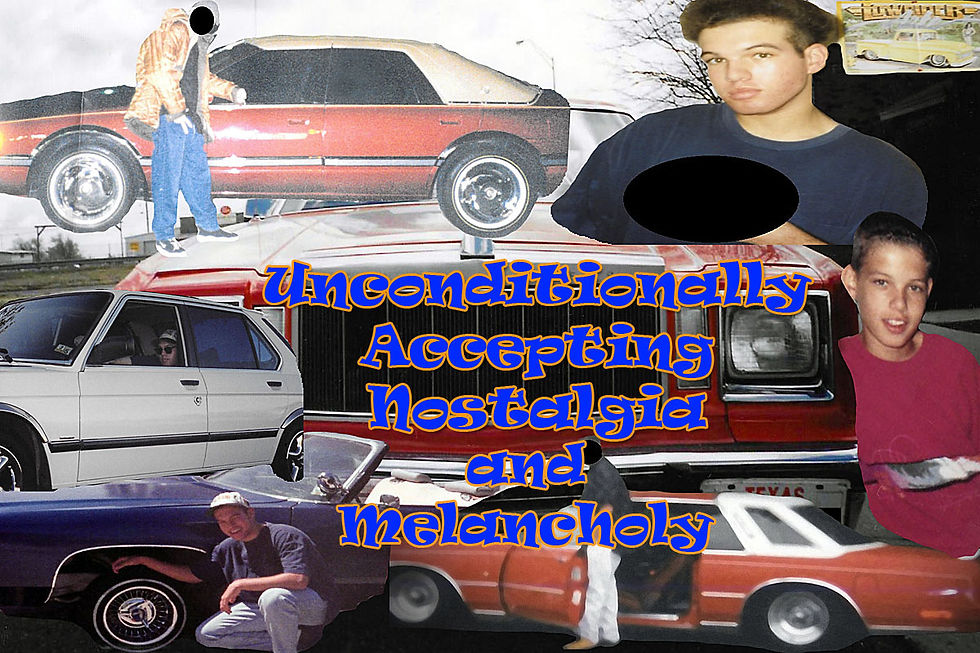
While aware of the fact that the proverbial ride of life inevitably ends, as I’m waiting for my ride to show up (any day now!), I reflect upon the literal rides in which I’ve traveled throughout the years. For context, in urban vernacular, a ride refers to a vehicle (e.g., a 1964 Chevrolet Impala).
When reminiscing in this fashion, I’m reminded of my dad’s yellow fifth generation Lincoln Continental. When I was a young boy, my dad used to take me for rides (i.e., driving activities by way of a vehicle) through the North Heights area of Bomb City.
Thinking back, I experience nostalgia, which the American Psychological Association defines as “a longing to return to an earlier period or condition of life recalled as being better than the present in some way” and “a longing to return to a place to which one feels emotionally bound.”
I enjoyed going on rides in my dad’s ride, as I now experience nostalgia along my proverbial ride of life while waiting for my inevitable ride to show up (i.e., death). Echoing within my memories of cruising North Heights is the song “Low Rider” by the band War and Jerry Goldstein.
Featured on the album Why Can’t We Be Friends? (1975), one source states of the track, “The lyric takes the cool, laidback image of the lowrider— the Chicano culture practice of hydraulically hot-rodding classic cars— and using innuendo, extends the image to a lifestyle.”
Although my dad’s ‘70s ride wasn’t technically a lowrider (a customized car with a lowered body that emerged in the post-WWII, 1940s–1950s era), it was precisely the sort of vehicle that would’ve been modified by the time I later arrived to my adolescent years.
Having been sent to live with my dad in Aurora, Colorado from half of my fifth grade year to half of my seventh grade year, I was returned to live with my mom in Bomb City. While in Aurora, I’d befriended members of the Crips in the late ‘80s and early ‘90s.
On the first week back in Bomb City, my older sister was eager to introduce me to her friends—members of a lowrider min-truck car club that was referred to as the Eight Ball Posse. “C’mere,” my sister encouraged me, “I want you to meet my friend with a Pink Panther mini-truck.”
She introduced me to a Mexican high school boy whose lowrider pickup truck was painted pink. I walked up to the guy who was surrounded by other teenagers and said, “What set you claimin’, cuzz?” Out of approximately 25 to 50 people in the parking lot, no one understood my question.
As I’d learned from my Crip friends, challenging supposed gang members was a method of purity testing (assessing standards used to judge one’s in-group and out-group distinction). “Man,” I then stated, “y’all ain’t no gangstas!” My sister promptly removed me from the scene.
Even regarding that event, I experience nostalgia. Turns out, the Eight Ball Posse wasn’t a criminal street gang. They were merely a group of mini-truckers in Bomb City who were gathered in a parking lot while listening to Sir Mix-a-Lot’s album Swass (1988).
Several years later, having resided in a children’s home and then been invited to live with a family at the start of my sophomore year of high school, I hung out in parking lots of Bomb City. During that time, a lowrider mini-truck car club referred to as the Midnight Mafia filled the lots.
While they weren’t gang-affiliated, I’d also befriended Bomb City members of the Crips, Bloods, and Sureños. The latter predominately Mexican criminal street gang members were fond of lowriders. Their method of cruising in a lo-lo (i.e., lowrider) was as slow as possible.
Back then, I don’t recall the term SLAB (slow, low, and bangin’) being used. However, its later use in the Texas hip hop subculture appropriately described how lowriders navigated the streets of Bomb City. It was as though lo-lo’s were reading Braille with the undercarriage of the rides.
Deep potholes, elevated speedbumps, and other obstructions on the roadways were felt as lowriders cruised the calles of the city. Thinking back, I’m reminded of the song “Low Rider (On the Boulevard)” by rappers Kid Frost, A.L.T., Mellow Man Ace, and Markski, with War.
It was featured on the album Latin Alliance (1991), as I read Lowrider magazine during that time. Also, my friend Lil’ Caesar (brother of The Pink Panther mini-trucker) shared my interest in lowriders. During those days, many teens in Bomb City knew who drove which lo-lo’s.
It was also common knowledge as to whose rides were stolen, dissected in chop shops, and divvied up among other lowrider aficionados in Bomb City. All the same, there’ll be no dry-snitchin’ in this blogpost. If you were in the lowrider scene back then, then you likely know.
I’d be lying if I said there wasn’t an element of excitement regarding violent exchanges on major roadways (e.g., drive-by shootings) and components of surprise concerning suicide turns (i.e., driving head-on toward oncoming traffic, and then abruptly turning in another direction).
As fallible human beings, Bomb City adolescents engaged in maladaptive behavior. For instance, when cruising back to Amarillo High School from our lunchbreak, I had to physically subdue my friend 1/2 Ton as he quickly exited his ride in response to someone spitting on his lowrider.
The prep who hawked a loogie had no idea what my friend would’ve done if I weren’t able to restrain him. 1/2 Ton didn’t even put his ride in park before exiting to serve knuckle sandwiches! Even regarding this memory, I now experience nostalgia. Of this matter, one source states:
Nostalgia is an emotion which is often described as a bittersweet longing for the past, typically for a period of time accompanied by happy memories or emotions. It is often described as a sort of sad pleasure, which typically involves longing for a past memory, whether real or romanticized, that cannot be recovered. It can also refer to a type of homesickness.
It may be tempting for an individual to regard nostalgia as something akin to a symptom of depression or melancholia (an archaic name for depression). In common parlance, melancholy suggests a pensive (musingly or dreamily thoughtful, suggestive of sad thoughtfulness) mood.
Still, it’s worth noting that nostalgia and melancholy aren’t clinical terms. Nevertheless, regarding these colloquial expressions which may influence artistic expression, a psychoeducational lesson on Rational Emotive Behavior Therapy (REBT) comes to mind.
Specifically, REBT uses unconditional acceptance (UA) to relieve self-induced suffering. This is accomplished through use of unconditional self-acceptance (USA), unconditional other-acceptance (UOA), and unconditional life-acceptance (ULA).
With my approach to REBT, I incorporate author Stephen Covey’s concepts regarding the circles of control, influence, and concern, as well as an area of no concern. UA maps onto the circle of control (USA), circle of influence (UOA), and circle of concern and area of no concern (ULA).
The circle of control encompasses only oneself, the circle of influence encapsulates elements which may be subject to one’s sway, the circle of concern engrosses most matters one can imagine, and the area of no concern relates to all content which isn’t yet imagined.
Regarding my circle of control and USA, I recognize that I can control my reaction to the experience of nostalgia and melancholy. Therefore, rather than lamenting the negative and healthy emotional state I’m experiencing, I choose to express gratitude for having lived fully.
Concerning my circle of influence and UOA, I admit that my ability to influence Lil’ Caesar and 1/2 Ton has passed. Thus, I couldn’t persuade former friends who were members of gangs to change their lives. Similarly, I couldn’t influence Lil’ Caesar and 1/2 Ton to remain in my life.
Relating to my circle of concern and ULA, I know that the past is passed. It’s inalterable. While it’s nostalgic to figuratively ride through the memories of my mind, reminiscing about rides of yesteryear, melancholy is merely a rest stop on the way to my ultimate destination (i.e., death).
As for my area of no concern, an imaginary realm in which lowriders serve as a method of literally transporting me back in time to relive memories of the past, that’s the stuff of dreams. While some people find value in wasting life in that regard, I don’t. So, I’ll live in reality.
In closing, while aware of the fact that the proverbial ride of life inevitably ends, as I’m waiting for my ride to show up (what’s taking so long?), I reflect upon the literal rides in which I’ve traveled throughout the years, as I unconditionally accept nostalgia and melancholy. And you?
If you’re looking for a provider who tries to work to help understand how thinking impacts physical, mental, emotional, and behavioral elements of your life—helping you to sharpen your critical thinking skills, I invite you to reach out today by using the contact widget on my website.
As the world’s foremost hip hop-influenced REBT psychotherapist, I’m pleased to try to help people with an assortment of issues from anger (hostility, rage, and aggression) to relational issues, adjustment matters, trauma experience, justice involvement, attention-deficit hyperactivity disorder, anxiety and depression, and other mood or personality-related matters.
At Hollings Therapy, LLC, serving all of Texas, I aim to treat clients with dignity and respect while offering a multi-lensed approach to the practice of psychotherapy and life coaching. My mission includes: Prioritizing the cognitive and emotive needs of clients, an overall reduction in client suffering, and supporting sustainable growth for the clients I serve. Rather than simply trying to help you to feel better, I want to try to help you get better!
Deric Hollings, LPC, LCSW
References:
Anonymous. (2003, December 31). Calle. Urban Dictionary. Retrieved from https://www.urbandictionary.com/define.php?term=calle
APA Dictionary of Psychology. (2018, April 19). Excitement. American Psychological Association. Retrieved from https://dictionary.apa.org/excitement
APA Dictionary of Psychology. (2018, April 19). Melancholia. American Psychological Association. Retrieved from https://dictionary.apa.org/melancholia
APA Dictionary of Psychology. (2018, April 19). Nostalgia. American Psychological Association. Retrieved from https://dictionary.apa.org/nostalgia
Apple Music. (n.d.). Markski. Apple Inc. Retrieved from https://music.apple.com/us/artist/markski/348388732
Carbrey, R. (2018, July 11). 20 wild lowrider pickups from the 90s. Valnet Inc. Retrieved from https://www.hotcars.com/20-wild-lowrider-mini-pickups-from-the-90s/
Furtado, D. (2022, January 19). Advocates muse on factors to revitalize North Heights. Sinclair, Inc. Retrieved from https://abc7amarillo.com/news/local/advocates-muse-on-factors-to-revitalize-north-heights
Hollings, D. (2025, December 8). A gangsta condition, cuh. Hollings Therapy, LLC. Retrieved from https://www.hollingstherapy.com/post/a-gangsta-condition-cuh
Hollings, D. (2026, February 8). Adaptive and maladaptive emotions and behavior. Hollings Therapy, LLC. Retrieved from https://www.hollingstherapy.com/post/adaptive-and-maladaptive-emotions-and-behavior
Hollings, D. (2025, November 19). An erudite know-it-all engaging in virtue signaling and purity testing. Hollings Therapy, LLC. Retrieved from https://www.hollingstherapy.com/post/an-erudite-know-it-all-engaging-in-virtue-signaling-and-purity-testing
Hollings, D. (2025, September 18). Are you working against your interests and goals? Hollings Therapy, LLC. Retrieved from https://www.hollingstherapy.com/post/are-you-working-against-your-interests-and-goals
Hollings, D. (2023, October 6). Arguing attributes of ability. Hollings Therapy, LLC. Retrieved from https://www.hollingstherapy.com/post/arguing-attributes-of-ability
Hollings, D. (2025, October 31). Best to live your life to the fullest. Hollings Therapy, LLC. Retrieved from https://www.hollingstherapy.com/post/best-to-live-your-life-to-the-fullest
Hollings, D. (2024, October 22). Big gangsta. Hollings Therapy, LLC. Retrieved from https://www.hollingstherapy.com/post/big-gangsta
Hollings, D. (2022, May 17). Circle of concern. Hollings Therapy, LLC. Retrieved from https://www.hollingstherapy.com/post/circle-of-concern
Hollings, D. (2024, July 11). Concern and no concern. Hollings Therapy, LLC. Retrieved from https://www.hollingstherapy.com/post/concern-and-no-concern
Hollings, D. (2023, April 22). Control. Hollings Therapy, LLC. Retrieved from https://www.hollingstherapy.com/post/control
Hollings, D. (2025, October 31). Depression and reasoned choice. Hollings Therapy, LLC. Retrieved from https://www.hollingstherapy.com/post/depression-and-reasoned-choice
Hollings, D. (2022, March 15). Disclaimer. Hollings Therapy, LLC. Retrieved from https://www.hollingstherapy.com/post/disclaimer
Hollings, D. (2025, March 2). Disturbed about symptoms. Hollings Therapy, LLC. Retrieved from https://www.hollingstherapy.com/post/disturbed-about-symptoms
Hollings, D. (2026, May 10). Doing what I can before my ride shows up. Hollings Therapy, LLC. Retrieved from https://www.hollingstherapy.com/post/doing-what-i-can-before-my-ride-shows-up
Hollings, D. (2026, June 23). Don’t nobody else make me feel like: Sadness. Hollings Therapy, LLC. Retrieved from https://www.hollingstherapy.com/post/don-t-nobody-else-make-me-feel-like-sadness
Hollings, D. (2024, May 11). Fallible human being. Hollings Therapy, LLC. Retrieved from https://www.hollingstherapy.com/post/fallible-human-being
Hollings, D. (2024, May 17). Feeling better vs. getting better. Hollings Therapy, LLC. Retrieved from https://www.hollingstherapy.com/post/feeling-better-vs-getting-better-1
Hollings, D. (2023, October 12). Get better. Hollings Therapy, LLC. Retrieved from https://www.hollingstherapy.com/post/get-better
Hollings, D. (2026, April 24). Gratitude: Awu wemadoda. Hollings Therapy, LLC. Retrieved from https://www.hollingstherapy.com/post/gratitude-awu-wemadoda
Hollings, D. (2026, July 20). Had to. Hollings Therapy, LLC. Retrieved from https://www.hollingstherapy.com/post/had-to
Hollings, D. (2024, September 24). Happy place. Hollings Therapy, LLC. Retrieved from https://www.hollingstherapy.com/post/happy-place
Hollings, D. (2024, August 9). Healthy concern. Hollings Therapy, LLC. Retrieved from https://www.hollingstherapy.com/post/healthy-concern
Hollings, D. (2026, June 6). High and dry: Steering a proverbial ship around unhelpful assumptions. Hollings Therapy, LLC. Retrieved from https://www.hollingstherapy.com/post/high-and-dry-steering-a-proverbial-ship-around-unhelpful-assumptions
Hollings, D. (n.d.). Hollings Therapy, LLC [Official website]. Hollings Therapy, LLC. Retrieved from https://www.hollingstherapy.com/
Hollings, D. (2024, August 21). In-group and out-group distinction. Hollings Therapy, LLC. Retrieved from https://www.hollingstherapy.com/post/in-group-and-out-group-distinction
Hollings, D. (2026, April 3). It is more human to laugh at life than to lament it. Hollings Therapy, LLC. Retrieved from https://www.hollingstherapy.com/post/it-is-more-human-to-laugh-at-life-than-to-lament-it
Hollings, D. (2026, July 6). It’s not an opinion, it’s a fact: Am I taking crazy pills? Hollings Therapy, LLC. Retrieved from https://www.hollingstherapy.com/post/it-s-not-an-opinion-it-s-a-fact-am-i-taking-crazy-pills
Hollings, D. (2025, April 23). Judgment. Hollings Therapy, LLC. Retrieved from https://www.hollingstherapy.com/post/judgment
Hollings, D. (2025, October 13). Knowledge, wisdom, understanding. Hollings Therapy, LLC. Retrieved from https://www.hollingstherapy.com/post/knowledge-wisdom-understanding
Hollings, D. (2025, May 18). Learning to understand, attentively and deeply. Hollings Therapy, LLC. Retrieved from https://www.hollingstherapy.com/post/learning-to-understand-attentively-and-deeply
Hollings, D. (2023, September 19). Life coaching. Hollings Therapy, LLC. Retrieved from https://www.hollingstherapy.com/post/life-coaching
Hollings, D. (2026, May 17). Listening to reason through argument: Is the rhetoric of whataboutism persuasive? Hollings Therapy, LLC. Retrieved from https://www.hollingstherapy.com/post/listening-to-reason-through-argument-is-the-rhetoric-of-whataboutism-persuasive
Hollings, D. (2023, September 8). Lived experience. Hollings Therapy, LLC. Retrieved from https://www.hollingstherapy.com/post/lived-experience
Hollings, D. (2026, April 4). Objective reality. Hollings Therapy, LLC. Retrieved from https://www.hollingstherapy.com/post/objective-reality
Hollings, D. (2023, September 3). On feelings. Hollings Therapy, LLC. Retrieved from https://www.hollingstherapy.com/post/on-feelings
Hollings, D. (2026, May 9). Political violence: Freedom’s got a shotgun. Hollings Therapy, LLC. Retrieved from https://www.hollingstherapy.com/post/political-violence-freedom-s-got-a-shotgun
Hollings, D. (2024, January 1). Psychoeducation. Hollings Therapy, LLC. Retrieved from https://www.hollingstherapy.com/post/psychoeducation
Hollings, D. (2024, May 5). Psychotherapist. Hollings Therapy, LLC. Retrieved from https://www.hollingstherapy.com/post/psychotherapist
Hollings, D. (2022, March 24). Rational emotive behavior therapy (REBT). Hollings Therapy, LLC. Retrieved from https://www.hollingstherapy.com/post/rational-emotive-behavior-therapy-rebt
Hollings, D. (2024, March 14). REBT and emotions. Hollings Therapy, LLC. Retrieved from https://www.hollingstherapy.com/post/rebt-and-emotions
Hollings, D. (2023, February 17). Revisiting the circle of control. Hollings Therapy, LLC. Retrieved from https://www.hollingstherapy.com/post/revisiting-the-circle-of-control
Hollings, D. (2025, January 15). Satisfaction. Hollings Therapy, LLC. Retrieved from https://www.hollingstherapy.com/post/satisfaction
Hollings, D. (2025, October 9). Self-awareness, self-examination, and self-determination. Hollings Therapy, LLC. Retrieved from https://www.hollingstherapy.com/post/self-awareness-self-examination-and-self-determination
Hollings, D. (2026, July 25). Self-reflection: That ignorant kid, he’s still livin’ inside of me. Hollings Therapy, LLC. Retrieved from https://www.hollingstherapy.com/post/self-reflection-that-ignorant-kid-he-s-still-livin-inside-of-me
Hollings, D. (2026, May 31). Standards and principles. Hollings Therapy, LLC. Retrieved from https://www.hollingstherapy.com/post/standards-and-principles
Hollings, D. (2025, October 27). Suicide and suicide attempts: Jumping out the window. Hollings Therapy, LLC. Retrieved from https://www.hollingstherapy.com/post/suicide-and-suicide-attempts-jumping-out-the-window
Hollings, D. (2025, October 19). Surprise and embarrassment. Hollings Therapy, LLC. Retrieved from https://www.hollingstherapy.com/post/surprise-and-embarrassment
Hollings, D. (2026, April 12). The Cartesian crisis: What do I control? What do I influence? Hollings Therapy, LLC. Retrieved from https://www.hollingstherapy.com/post/ the-cartesian-crisis-what-do-i-control-what-do-i-influence
Hollings, D. (2025, June 18). The gift of memory lives on. Hollings Therapy, LLC. Retrieved from https://www.hollingstherapy.com/post/the-gift-of-memory-lives-on
Hollings, D. (2025, February 13). The past is passed. Hollings Therapy, LLC. Retrieved from https://www.hollingstherapy.com/post/the-past-is-passed
Hollings, D. (2026, April 23). The three traditionally identified components of the mind: Affect, cognition, and conation. Hollings Therapy, LLC. Retrieved from https://www.hollingstherapy.com/post/the-three-traditionally-identified-components-of-the-mind-affect-cognition-and-conation
Hollings, D. (2024, February 6). This ride inevitably ends. Hollings Therapy, LLC. Retrieved from https://www.hollingstherapy.com/post/this-ride-inevitably-ends
Hollings, D. (2025, February 28). To try is my goal. Hollings Therapy, LLC. Retrieved from https://www.hollingstherapy.com/post/to-try-is-my-goal
Hollings, D. (2024, October 20). Unconditional acceptance redux. Hollings Therapy, LLC. Retrieved from https://www.hollingstherapy.com/post/unconditional-acceptance-redux
Hollings, D. (2023, March 11). Unconditional life-acceptance. Hollings Therapy, LLC. Retrieved from https://www.hollingstherapy.com/post/unconditional-life-acceptance
Hollings, D. (2023, February 25). Unconditional other-acceptance. Hollings Therapy, LLC. Retrieved from https://www.hollingstherapy.com/post/unconditional-other-acceptance
Hollings, D. (2023, March 1). Unconditional self-acceptance. Hollings Therapy, LLC. Retrieved from https://www.hollingstherapy.com/post/unconditional-self-acceptance
Hollings, D. (2024, March 18). Unhealthy vs. healthy negative emotions. Hollings Therapy, LLC. Retrieved from https://www.hollingstherapy.com/post/unhealthy-vs-healthy-negative-emotions
Hollings, D. (2025, February 9). Value. Hollings Therapy, LLC. Retrieved from https://www.hollingstherapy.com/post/value
Hollings, D. (2024, August 20). We all make our choices. Hollings Therapy, LLC. Retrieved from https://www.hollingstherapy.com/post/we-all-make-our-choices
Hollings, D. (2026, May 17). When things are screwed up, change what you can, and accept everything else. Hollings Therapy, LLC. Retrieved from https://www.hollingstherapy.com/post/when-things-are-screwed-up-change-what-you-can-and-accept-everything-else
Hollings, D. (2024, April 17). Wishes, dreams, and goals. Hollings Therapy, LLC. Retrieved from https://www.hollingstherapy.com/post/wishes-dreams-and-goals
Hollings, D. (2026, March 8). You are not your beliefs or ideas. Hollings Therapy, LLC. Retrieved from https://www.hollingstherapy.com/post/you-are-not-your-beliefs-or-ideas
Hollings, D. (2026, March 26). You’ll have suffered twice. Hollings Therapy, LLC. Retrieved from https://www.hollingstherapy.com/post/you-ll-have-suffered-twice
Mashetee88. (2015, September 27). Dry snitching. Urban Dictionary. Retrieved from https://www.urbandictionary.com/define.php?term=dry+snitching
Percplus. (2016, June 10). Lowrider (On the Boulevard) [Video]. YouTube. Retrieved from https://youtu.be/0xQrgeGbGjo?si=6lAR_S3aUxYRhGb0
War. (2021, May 12). War - Low Rider (Official video) [Remastered in 4K] [Video]. YouTube. Retrieved from https://youtu.be/BsrqKE1iqqo?si=PIyCBhkL_zFZkjj5
Wikipedia. (n.d.). A.L.T. Retrieved from https://en.wikipedia.org/wiki/A.L.T.
Wikipedia. (n.d.). Amarillo High School. Retrieved from https://en.wikipedia.org/wiki/Amarillo_High_School
Wikipedia. (n.d.). Bloods. Retrieved from https://en.wikipedia.org/wiki/Bloods
Wikipedia. (n.d.). Braille. Retrieved from https://en.wikipedia.org/wiki/Braille
Wikipedia. (n.d.). Chevrolet Impala. Retrieved from https://en.wikipedia.org/wiki/Chevrolet_Impala#Third_generation_(1961%E2%80%931964)
Wikipedia. (n.d.). Chicano. Retrieved from https://en.wikipedia.org/wiki/Chicano
Wikipedia. (n.d.). Chop shop. Retrieved from https://en.wikipedia.org/wiki/Chop_shop
Wikipedia. (n.d.). Crips. Retrieved from https://en.wikipedia.org/wiki/Crips
Wikipedia. (n.d.). Drive-by shooting. Retrieved from https://en.wikipedia.org/wiki/Drive-by_shooting
Wikipedia. (n.d.). Frost (rapper). Retrieved from https://en.wikipedia.org/wiki/Frost_(rapper)
Wikipedia. (n.d.). Homesickness. Retrieved from https://en.wikipedia.org/wiki/Homesickness
Wikipedia. (n.d.). Jerry Goldstein (producer). Retrieved from https://en.wikipedia.org/wiki/Jerry_Goldstein_(producer)
Wikipedia. (n.d.). Latin Alliance (album). Retrieved from https://en.wikipedia.org/wiki/Latin_Alliance_(album)
Wikipedia. (n.d.). Lincoln Continental. Retrieved from https://en.wikipedia.org/wiki/Lincoln_Continental#Fifth_generation_(1970%E2%80%931979)
Wikipedia. (n.d.). Low Rider. Retrieved from https://en.wikipedia.org/wiki/Low_Rider
Wikipedia. (n.d.). Lowrider. Retrieved from https://en.wikipedia.org/wiki/Lowrider
Wikipedia. (n.d.). Lowrider (magazine). Retrieved from https://en.wikipedia.org/wiki/Lowrider_(magazine)
Wikipedia. (n.d.). Mellow Man Ace. Retrieved from https://en.wikipedia.org/wiki/Mellow_Man_Ace
Wikipedia. (n.d.). Nostalgia. Retrieved from https://en.wikipedia.org/wiki/Nostalgia
Wikipedia. (n.d.). Preppie (disambiguation). Retrieved from https://en.wikipedia.org/wiki/Preppie_(disambiguation)
Wikipedia. (n.d.). Rest area. Retrieved from https://en.wikipedia.org/wiki/Rest_area
Wikipedia. (n.d.). Romanticization. Retrieved from https://en.wikipedia.org/wiki/Romanticization
Wikipedia. (n.d.). Set (gang). Retrieved from https://en.wikipedia.org/wiki/Set_(gang)
Wikipedia. (n.d.). Sir Mix-a-Lot. Retrieved from https://en.wikipedia.org/wiki/Sir_Mix-a-Lot
Wikipedia. (n.d.). Stephen Covey. Retrieved from https://en.wikipedia.org/wiki/Stephen_Covey
Wikipedia. (n.d.). Sureños. Retrieved from https://en.wikipedia.org/wiki/Sure%C3%B1os
Wikipedia. (n.d.). Swass. Retrieved from https://en.wikipedia.org/wiki/Swass
Wikipedia. (n.d.). The Pink Panther. Retrieved from https://en.wikipedia.org/wiki/The_Pink_Panther
Wikipedia. (n.d.). War (band). Retrieved from https://en.wikipedia.org/wiki/War_(band)
Wikipedia. (n.d.). Why Can’t We Be Friends? Retrieved from https://en.wikipedia.org/wiki/Why_Can't_We_Be_Friends%3F
Wordorigins.org. (2020, December 18). Hawk a loogie. Retrieved from https://www.wordorigins.org/big-list-entries/hawk-a-loogie


