Negative, but Unhealthy Sadness: You Aren’t Disturbed by Events From Childhood

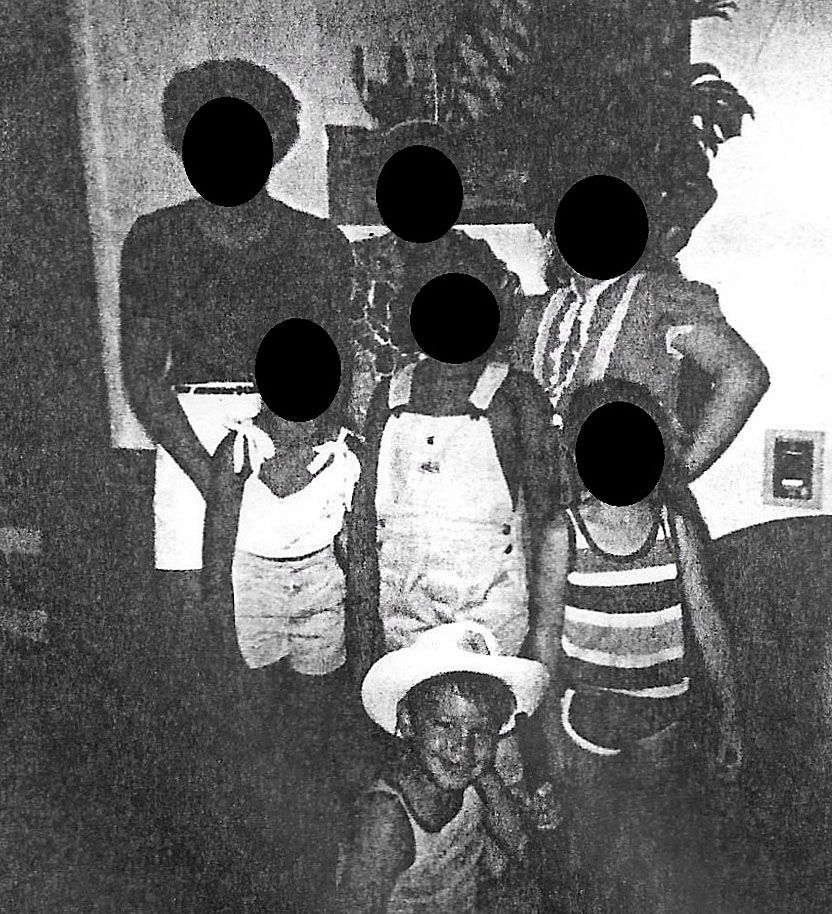
In the above photo, I’m depicted holding a toy rifle while posing with my female sisters and cousins. Three people in that picture were said to have been sexually assaulted and/or raped by members of our family. Yet, I knew nothing about this matter until I became an adult.
During a time when I owned real rifles and would likely have sought subjective justice against the alleged offenders, I had a discussion with one of the family members in the photo above. “Why didn’t you tell me?” I asked, not knowing that my question correlated with shame.
“Deric,” my family member replied, “even though what [purported offending family member] did was bad, I didn’t want to make things worse by telling you. I’ve known what you’re like, even as a child, you would’ve killed him! I didn’t want to lose you.” Her view was accurate.
I likely would’ve cut off his head, as I’d threatened to do with my late mom and dad—both who subjected me to years of traumatic events—because that’s how I once subjectively viewed justice. Killing a purported offending family member in this way represented an act of fairness.
The unhealthy worldview I had at that time, whereby I’d readily commit homicide (a killing of one human being by another), more specifically murder (the crime of unlawfully and unjustifiably killing a person) is one that I no longer maintain. Things have changed!
In particular, I’ve since practiced personal and professional care for mental, emotional, and behavioral health (collectively “mental health”). Herein, I’ll share one method that aided in my ability to practice rational living, as I haven’t advocated murderous acts in decades!
As Rational Emotive Behavior Therapy (REBT) was formed by the late psychologist Albert Ellis, who reportedly developed the first cognitive behavior therapy (CBT) psychotherapeutic modality in 1955, this blog entry is part of an ongoing series regarding his book, Ask Albert Ellis?: Straight Answers and Sound Advice from America’s Best-Known Psychologist.
REBT uses the ABC model to illustrate that when an undesirable Action occurs and you Believe an unhelpful narrative about the event, it’s your unfavorable assumption, not the occurrence itself, that causes an unpleasant Consequence. This is known as distress or disturbance.
Noteworthy, with virtually any undesirable Action that occurs, it’s your unfavorable Beliefs which cause unpleasant distress or disturbance (Consequence). Given this framing of self-distress and self-disturbance, it’s worth noting that one REBT source states (page 71):
REBT conceptualizes [distress] as healthy even though it is intense. Other approaches to therapy have as their goal the reduction of the intensity of negative emotions. They take this position because they do not keenly differentiate between healthy negative emotions (distress) and unhealthy negative emotions (disturbance).
Now, REBT keenly distinguishes between healthy distress and unhealthy disturbance. Healthy distress stems from your rational beliefs about a negative activating event [Action], whilst disturbance stems from your irrational beliefs about the same event.
Complete elimination of distress is highly unlikely in an impermanent and uncertain world wherein people conceptually suffer, struggle, and battle with, or merely experience hardship. Still, individuals often make matters worse for themselves by disturbing about such instances.
In particular, there are four predominate irrational beliefs which people often use to distress or disturb themselves: global evaluations, low frustration tolerance, awfulizing, and demandingness. When contemplating these unproductive scripts, think of the acronym GLAD.
Additionally, from a psychological standpoint, people distress or disturb themselves using a Belief-Consequence (B-C) connection. Of course, this isn’t to suggest that in the context of the naturalistic or physical world there is no Action-Consequence (A-C) connection.
From an A-C view, a purported offending family member allegedly sexually abused two of my close female family members (Action), as these family members apparently endured years of abuse (Consequence). Still, people’s B-C connections aren’t what cause self-disturbance.
My female family members were allegedly molested (Action) and they hypothetically Believed, “Life is meaningless without proper adult protection [G], and we can’t tolerate [purported offending family member] [L], as he’s horrible [A], and he mustn’t have done what he did [D]!”
As I have no way of accessing the inner-workings of my female family members’ minds, this GLAD Belief is strictly conjectural. If you’re willing to entertain this plausible self-narrative, I submit that such a Belief would then cause negative, but unhealthy sadness (Consequence).
For context, the American Psychological Association defines sadness as “an emotional state of unhappiness, ranging in intensity from mild to extreme and usually aroused by the loss of something that is highly valued (e.g., by the rupture of a relationship). Persistent sadness is one of the two defining symptoms of a major depressive episode, the other being anhedonia.”
Addressing how people upset themselves with unhelpful attitudes, the ABC model incorporates Disputation of unproductive philosophies of life in order to explore Effective new beliefs. Whereas rigid beliefs cause self-disturbance, flexible beliefs result in an un-disturbed condition.
Herein, I’ve not made a value judgment (a judgement of the rightness or wrongness of something or someone, or of the usefulness of something or someone) regarding my purported offending family member, my female family members, or even sexual assault and rape.
Rather, I’ve demonstrated what causes negative, but unhealthy sadness. Even as I find sexual assault and rape highly disagreeable, especially when involving children, more particularly when concerning my own family members, I’ve outlined how the B-C connection causes disturbance.
Now, imagine that my female family members were allegedly molested (Action) and they hypothetically used the Effective belief, “Even though we would’ve preferred not to have been molested, we were. Therefore, we don’t have to make the act worse with our Beliefs about it!”
I suppose that when using this Effective new belief, my female family members would’ve experienced negative, though healthy sadness (Consequence). Regarding the matter of disturbance in relation to childhood events, Ellis stated (page 4):
REBT is the original Cognitive Behavioral Therapy, and the first major therapy to recognize that people have choices about how they respond to life events – that everything is not dictated by the past.
People do not really get disturbed by their early childhood and things that happen to them later, but they mainly disturb themselves – and they can choose to disturb themselves about these things or not.
It would be a matter of unfalsifiability to state with certainty as to whether or not I actually would’ve beheaded a purported offending family member or the other female family member who ostensibly offered up my underage female family members to this fallible human being.
Being the flawed child that I was, I likely would’ve murdered both adults and waited for law enforcement officers to show up, as I displayed a proud grin (see photo above). That outcome, too, would’ve been caused by a B-C connection. Still, due to my ignorance, it never came to that.
Favorably, I haven’t utilized such unhealthy B-C connections in many years! This is a direct cause of having practiced REBT. Now, I invite you to consider use of this helpful CBT tool. Even if you’re not inclined to murderous acts, the ABC model may still be of some use to you.
If you’re looking for a provider who tries to work to help understand how thinking impacts physical, mental, emotional, and behavioral elements of your life—helping you to sharpen your critical thinking skills, I invite you to reach out today by using the contact widget on my website.
As a psychotherapist, I’m pleased to try to help people with an assortment of issues ranging from anger (hostility, rage, and aggression) to relational issues, adjustment matters, trauma experience, justice involvement, attention-deficit hyperactivity disorder, anxiety and depression, and other mood or personality-related matters.
At Hollings Therapy, LLC, serving all of Texas, I aim to treat clients with dignity and respect while offering a multi-lensed approach to the practice of psychotherapy and life coaching. My mission includes: Prioritizing the cognitive and emotive needs of clients, an overall reduction in client suffering, and supporting sustainable growth for the clients I serve. Rather than simply trying to help you to feel better, I want to try to help you get better!
Deric Hollings, LPC, LCSW
References:
AEI. (n.d.). About Albert Ellis, Ph.D. Albert Ellis Institute. Retrieved from https://albertellis.org/about-albert-ellis-phd/
APA Dictionary of Psychology. (2018, April 19). Anhedonia. American Psychological Association. Retrieved from https://dictionary.apa.org/anhedonia
APA Dictionary of Psychology. (2023, November 15). Major depressive episode. American Psychological Association. Retrieved from https://dictionary.apa.org/major-depressive-episode
APA Dictionary of Psychology. (2018, April 19). Sadness. American Psychological Association. Retrieved from https://dictionary.apa.org/sadness
Dryden, W. and Neenan, M. (2006). Rational emotive behaviour therapy: 100 key points and techniques. Routledge. Retrieved from https://img1.wsimg.com/blobby/go/4b0e2552-2a18-4998-b44f-3a993148f7ac/downloads/REBT%202.pdf?ver=1627365797554
Ellis, A. (2003). Ask Albert Ellis?: Straight Answers and Sound Advice from America’s Best-Known Psychologist. Impact Publishers, Incorporated. Retrieved from https://www.welib.st/md5/acac369a25390ac87c98b93b00e3f33e
Halasz, G. (2004, December). In Conversation with Dr Albert Ellis. Australian Psychology. Retrieved from https://www.reasearchgate.net/publication/227984238_In_Conversation_with_Dr_Albert_Ellis
Hollings, D. (2026, June 16). A fountain of goodness: Subjective and objective views. Hollings Therapy, LLC. Retrieved from https://www.hollingstherapy.com/post/a-fountain-of-goodness-subjective-and-objective-views
Hollings, D. (2025, October 19). Adhering to invisible scripts. Hollings Therapy, LLC. Retrieved from https://www.hollingstherapy.com/post/adhering-to-invisible-scripts
Hollings, D. (2024, November 15). Assumptions. Hollings Therapy, LLC. Retrieved from https://www.hollingstherapy.com/post/assumptions
Hollings, D. (2026, September 8). Attention: Changing the way you respond to a situation makes a difference. Hollings Therapy, LLC. Retrieved from https://www.hollingstherapy.com/post/attention-changing-the-way-you-respond-to-a-situation-makes-a-difference
Hollings, D. (2024, August 7). Awfulizing. Hollings Therapy, LLC. Retrieved from https://www.hollingstherapy.com/post/awfulizing
Hollings, D. (2025, October 2). Because of x, the effect is y. Hollings Therapy, LLC. Retrieved from https://www.hollingstherapy.com/post/because-of-x-the-effect-is-y
Hollings, D. (2022, November 18). Big T, little t. Hollings Therapy, LLC. Retrieved from https://www.hollingstherapy.com/post/big-t-little-t
Hollings, D. (2026, March 9). Bloodlust: Homicidal ideation. Hollings Therapy, LLC. Retrieved from https://www.hollingstherapy.com/post/bloodlust-homicidal-ideation
Hollings, D. (2024, May 19). Cognitive behavior therapy (CBT). Hollings Therapy, LLC. Retrieved from https://www.hollingstherapy.com/post/cognitive-behavior-therapy-cbt
Hollings, D. (2024, October 27). Correlation does not imply causation. Hollings Therapy, LLC. Retrieved from https://www.hollingstherapy.com/post/correlation-does-not-imply-causation
Hollings, D. (2022, October 31). Demandingness. Hollings Therapy, LLC. Retrieved from https://www.hollingstherapy.com/post/demandingness
Hollings, D. (2022, March 15). Disclaimer. Hollings Therapy, LLC. Retrieved from https://www.hollingstherapy.com/post/disclaimer
Hollings, D. (2026, May 18). Displeasing: Choose how you will suffer. Hollings Therapy, LLC. Retrieved from https://www.hollingstherapy.com/post/displeasing-choose-how-you-will-suffer
Hollings, D. (2025, March 12). Distress vs. disturbance. Hollings Therapy, LLC. Retrieved from https://www.hollingstherapy.com/post/distress-vs-disturbance
Hollings, D. (2025, August 19). Doing right or wrong, as they see it. Hollings Therapy, LLC. Retrieved from https://www.hollingstherapy.com/post/doing-right-or-wrong-as-they-see-it
Hollings, D. (2026, June 23). Don’t nobody else make me feel like: Sadness. Hollings Therapy, LLC. Retrieved from https://www.hollingstherapy.com/post/don-t-nobody-else-make-me-feel-like-sadness
Hollings, D. (2024, May 11). Fallible human being. Hollings Therapy, LLC. Retrieved from https://www.hollingstherapy.com/post/fallible-human-being
Hollings, D. (2024, May 17). Feeling better vs. getting better. Hollings Therapy, LLC. Retrieved from https://www.hollingstherapy.com/post/feeling-better-vs-getting-better-1
Hollings, D. (2026, February 13). Five, four, three… beliefs. Hollings Therapy, LLC. Retrieved from https://www.hollingstherapy.com/post/five-four-three-beliefs
Hollings, D. (2023, October 12). Get better. Hollings Therapy, LLC. Retrieved from https://www.hollingstherapy.com/post/get-better
Hollings, D. (2023, September 13). Global evaluations. Hollings Therapy, LLC. Retrieved from https://www.hollingstherapy.com/post/global-evaluations
Hollings, D. (2024, April 13). Goals. Hollings Therapy, LLC. Retrieved from https://www.hollingstherapy.com/post/goals
Hollings, D. (2024, August 27). Guilt and shame are choices. Hollings Therapy, LLC. Retrieved from https://www.hollingstherapy.com/post/guilt-and-shame-are-choices
Hollings, D. (n.d.). Hollings Therapy, LLC [Official website]. Hollings Therapy, LLC. Retrieved from https://www.hollingstherapy.com/
Hollings, D. (2024, October 21). Impermanence and uncertainty. Hollings Therapy, LLC. Retrieved from https://www.hollingstherapy.com/post/impermanence-and-uncertainty
Hollings, D. (2024, February 14). Insufferable vs. undesirable. Hollings Therapy, LLC. Retrieved from https://www.hollingstherapy.com/post/insufferable-vs-undesirable
Hollings, D. (2025, April 23). Judgment. Hollings Therapy, LLC. Retrieved from https://www.hollingstherapy.com/post/judgment
Hollings, D. (2023, September 19). Life coaching. Hollings Therapy, LLC. Retrieved from https://www.hollingstherapy.com/post/life-coaching
Hollings, D. (2022, December 2). Low frustration tolerance. Hollings Therapy, LLC. Retrieved from https://www.hollingstherapy.com/post/low-frustration-tolerance
Hollings, D. (2024, March 4). Mental, emotional, and behavioral health. Hollings Therapy, LLC. Retrieved from https://www.hollingstherapy.com/post/mental-emotional-and-behavioral-health
Hollings, D. (2025, November 16). Mental health, mental illness, and mental disorder. Hollings Therapy, LLC. Retrieved from https://www.hollingstherapy.com/post/mental-health-mental-illness-and-mental-disorder
Hollings, D. (2025, October 2). Murderer, your insides must be hollow. Hollings Therapy, LLC. Retrieved from https://www.hollingstherapy.com/post/murderer-your-insides-must-be-hollow
Hollings, D. (2024, September 27). My attitude. Hollings Therapy, LLC. Retrieved from https://www.hollingstherapy.com/post/my-attitude
Hollings, D. (2025, August 2). My philosophy. Hollings Therapy, LLC. Retrieved from https://www.hollingstherapy.com/post/my-philosophy
Hollings, D. (2026, June 9). Nonsense: It’s plainly pride. Hollings Therapy, LLC. Retrieved from https://www.hollingstherapy.com/post/nonsense-it-s-plainly-pride
Hollings, D. (2026, April 19). Outcome: Victim mentality and playing the victim. Hollings Therapy, LLC. Retrieved from https://www.hollingstherapy.com/post/outcome-victim-mentality-and-playing-the-victim
Hollings, D. (2026, April 13). PLUR: Addressing sexual assault and rape. Hollings Therapy, LLC. Retrieved from https://www.hollingstherapy.com/post/plur-addressing-sexual-assault-and-rape
Hollings, D. (2023, September 15). Psychotherapeutic modalities. Hollings Therapy, LLC. Retrieved from https://www.hollingstherapy.com/post/psychotherapeutic-modalities
Hollings, D. (2024, May 5). Psychotherapist. Hollings Therapy, LLC. Retrieved from https://www.hollingstherapy.com/post/psychotherapist
Hollings, D. (2022, March 24). Rational emotive behavior therapy (REBT). Hollings Therapy, LLC. Retrieved from https://www.hollingstherapy.com/post/rational-emotive-behavior-therapy-rebt
Hollings, D. (2024, May 15). Rational living. Hollings Therapy, LLC. Retrieved from https://www.hollingstherapy.com/post/rational-living
Hollings, D. (2025, August 13). Rational versus irrational thoughts and beliefs. Hollings Therapy, LLC. Retrieved from https://www.hollingstherapy.com/post/rational-versus-irrational-thoughts-and-beliefs
Hollings, D. (2024, January 1). Rational vs. irrational. Hollings Therapy, LLC. Retrieved from https://www.hollingstherapy.com/post/rational-vs-irrational
Hollings, D. (2024, March 14). REBT and emotions. Hollings Therapy, LLC. Retrieved from https://www.hollingstherapy.com/post/rebt-and-emotions
Hollings, D. (2024, July 18). REBT flexibility. Hollings Therapy, LLC. Retrieved from https://www.hollingstherapy.com/post/rebt-flexibility
Hollings, D. (2024, January 4). Rigid vs. rigorous. Hollings Therapy, LLC. Retrieved from https://www.hollingstherapy.com/post/rigid-vs-rigorous
Hollings, D. (2026, July 7). Self-distress and distress tolerance. Hollings Therapy, LLC. Retrieved from https://www.hollingstherapy.com/post/self-distress-and-distress-tolerance
Hollings, D. (2022, November 1). Self-disturbance. Hollings Therapy, LLC. Retrieved from https://www.hollingstherapy.com/post/self-disturbance
Hollings, D. (2026, July 25). Self-reflection: That ignorant kid, he’s still livin’ inside of me. Hollings Therapy, LLC. Retrieved from https://www.hollingstherapy.com/post/self-reflection-that-ignorant-kid-he-s-still-livin-inside-of-me
Hollings, D. (2026, April 21). Self-upset. Hollings Therapy, LLC. Retrieved from https://www.hollingstherapy.com/post/self-upset
Hollings, D. (2025, December 24). Some people advocate walking. Hollings Therapy, LLC. Retrieved from https://www.hollingstherapy.com/post/some-people-advocate-walking
Hollings, D. (2024, February 27). Suffering, struggling, and battling vs. experiencing. Hollings Therapy, LLC. Retrieved from https://www.hollingstherapy.com/post/suffering-struggling-and-battling-vs-experiencing
Hollings, D. (2022, December 23). The A-C connection. Hollings Therapy, LLC. Retrieved from https://www.hollingstherapy.com/post/the-a-c-connection
Hollings, D. (2022, December 25). The B-C connection. Hollings Therapy, LLC. Retrieved from https://www.hollingstherapy.com/post/the-b-c-connection
Hollings, D. (2022, November 2). The critical A. Hollings Therapy, LLC. Retrieved from https://www.hollingstherapy.com/post/the-critical-a
Hollings, D. (2025, February 13). The past is passed. Hollings Therapy, LLC. Retrieved from https://www.hollingstherapy.com/post/the-past-is-passed
Hollings, D. (2026, April 23). The three traditionally identified components of the mind: Affect, cognition, and conation. Hollings Therapy, LLC. Retrieved from https://www.hollingstherapy.com/post/the-three-traditionally-identified-components-of-the-mind-affect-cognition-and-conation
Hollings, D. (2025, April 15). This cake smells unpleasant. Hollings Therapy, LLC. Retrieved from https://www.hollingstherapy.com/post/this-cake-smells-unpleasant
Hollings, D. (2026, June 5). To offend and endure offense: Você tem chulé. Hollings Therapy, LLC. Retrieved from https://www.hollingstherapy.com/post/to-offend-and-endure-offense-você-tem-chulé
Hollings, D. (2026, February 21). The preferences versus expectations paradigm: Love is not enough, though virtue is. Hollings Therapy, LLC. Retrieved from https://www.hollingstherapy.com/post/the-preferences-versus-expectations-paradigm-love-is-not-enough-though-virtue-is
Hollings, D. (2025, February 28). To try is my goal. Hollings Therapy, LLC. Retrieved from https://www.hollingstherapy.com/post/to-try-is-my-goal
Hollings, D. (2025, January 9). Traditional ABC model. Hollings Therapy, LLC. Retrieved from https://www.hollingstherapy.com/post/traditional-abc-model
Hollings, D. (2026, September 5). Trials: Subjective and objective views of justice and injustice. Hollings Therapy, LLC. Retrieved from https://www.hollingstherapy.com/post/trials-subjective-and-objective-views-of-justice-and-injustice
Hollings, D. (2023, October 22). Unfalsifiability. Hollings Therapy, LLC. Retrieved from https://www.hollingstherapy.com/post/unfalsifiability
Hollings, D. (2026, March 8). Unhappiness isn’t externally caused: You can hoot, hide, and talk that shit. Hollings Therapy, LLC. Retrieved from https://www.hollingstherapy.com/post/unhappiness-isn-t-externally-causes-you-can-hoot-hide-and-talk-that-shit
Hollings, D. (2024, March 18). Unhealthy vs. healthy negative emotions. Hollings Therapy, LLC. Retrieved from https://www.hollingstherapy.com/post/unhealthy-vs-healthy-negative-emotions
Hollings, D. (2024, October 26). Unhelpful expectations. Hollings Therapy, LLC. Retrieved from https://www.hollingstherapy.com/post/unhelpful-expectations
Hollings, D. (2024, November 1). Useful tools. Hollings Therapy, LLC. Retrieved from https://www.hollingstherapy.com/post/useful-tools
Hollings, D. (2025, February 9). Value. Hollings Therapy, LLC. Retrieved from https://www.hollingstherapy.com/post/value
Hollings, D. (2024, August 20). We all make our choices. Hollings Therapy, LLC. Retrieved from https://www.hollingstherapy.com/post/we-all-make-our-choices
Hollings, D. (2023, October 10). When others don’t share your worldview. Hollings Therapy, LLC. Retrieved from https://www.hollingstherapy.com/post/when-others-don-t-share-your-worldview
Hollings, D. (2026, August 19). Wisdom and acting justly are one and the same. Hollings Therapy, LLC. Retrieved from https://www.hollingstherapy.com/post/wisdom-and-acting-justly-are-one-and-the-same
Hollings, D. (2026, May 13). You don’t have to like me, but you have to act to like me. Hollings Therapy, LLC. Retrieved from https://www.hollingstherapy.com/post/you-don-t-have-to-like-me-but-you-have-to-act-to-like-me
Wikipedia. (n.d.). Value judgment. Retrieved from https://en.wikipedia.org/wiki/Value_judgment


