Higher Learning and Class Struggle: If There Is No Struggle, There Is No Progress

*Ladies First (2026) and Higher Learning (1995) spoilers contained herein.
Ladies First
I recently watched Ladies First (2026) while intentionally practicing Rational Emotive Behavior Therapy (REBT). As I patiently sat through the film, I created mental notes for a psychoeducational lesson on unity (a condition of harmony).
Yet, I rejected the feminist piece of propaganda, which the American Psychological Association defines as “a method of social control that attempts to strengthen or change the beliefs, attitudes, and actions of others by presenting highly biased information or sometimes disinformation.”
“Deric,” I reminded myself, “think back to when you unwittingly supported the mission of the Central Intelligence Agency [CIA] while assigned to the Marine Security Guard program. When you tried to warn others about the Agency’s propaganda, how did people respond?”
Many individuals called me “crazy” (not mentally sound) when I cautioned them about the CIA’s influence regarding procedures conducted in North, Central, and South America. “You’re crazy,” a composite of these people responded, “they can’t operate in the United States [U.S.].”
Per one source, Gloria Steinem—a pivotal figure in the history of feminism—“spoke openly about her relationship to The Agency in the 1950s and ‘60s after a magazine revealed her employment by a CIA front organization, the Independent Research Service.” She was a spook!
For the uninitiated, a “spook” is an operative, officer, agent, asset, or other adjunct of an intelligence entity (e.g., CIA). If spooks haven’t operated in U.S. borders since feminism visited this nation, then how does one explain Steinem’s feminist psychological operations (PSYOPs)?
Like Tulsi Gabbard—whose military occupational specialty was literally PSYOPs, and who questionably resigned her post as Director of National Intelligence due to an apparent family-related matter—spooks such as Steinem do operate within all of the Americas! Ask Gabbard!
“Whatever you have to say about feminists’ ties to the Agency and terrorism,” I told myself as I watched Ladies First, “will likely fall on willfully deaf ears.” Still, it wasn’t a struggle (to make strenuous or forceful efforts in the face of difficulties or opposition) for me to watch the film.
Regarding care for mental, emotional, and behavioral health (collectively “mental health”), I encourage people to use hyperbole (e.g., “struggle”) sparingly. This is because, from the view of the ABC model used in REBT, one can conflate mere inconvenience with actual struggle.
In so doing, an individual may transition from negative and healthy distress (e.g., frustration) to negative and unhealthy disturbance (e.g., rage). For example, suppose I interpreted Ladies First to be little more than feminist propaganda that was divisive (creating disunity).
I then took time to draft and post a blog entry about how much of the film’s message was irrational (not in accordance with both logic and reason). First, I didn’t enjoy the movie to begin with. Second, I would’ve probably wasted my time and effort writing about my opinions.
Last, even regarding my posts with relatively high view counts—mostly related to movie reviews through the lens of REBT, people would probably carry on with their preconceived notions anyway. If a feminist read my critique, then I doubt my opinion would change one’s mind.
Therefore, I decided to forego an in-depth examination of Ladies First, and instead re-watch a film that was released during my senior year of high school, Higher Learning (1995). “How might my perspective have shifted since I first saw the movie?” I asked myself.
Before I go any further, allow me to provide any feminists in the audience with an undesirable Activating event about which they can use unhelpful Beliefs which will cause an unpleasant Consequence, per the ABC model. This could be good practice for irrational thinkers!
The Higher Learning soundtrack included the R&B song “Ask of You” by Raphael Saadiq. On a number of occasions, when high school classes let out for the day, I’d walk over to my girlfriend’s house and we’d have sex to “Ask of You”. But wait, there’s more!
When re-watching Higher Learning earlier, hearing “Ask of You” during a sex scene, I thought about the times that my same-grade high school girlfriend and I used to knock boots, bump uglies, or engage in, as rapper Kyper used to say, “Is it sex? Oh, maybe so. Tic Tac Toe!”
There I sat, watching Higher Learning while knocking on the proverbial door of 50-years-old, thinking about “Tic Tac Toe” with my high school sweetheart. Now, feminists, disturb amongst yourselves as I instead use thinking which is rational (in accordance with both logic and reason).
For the remaining members of the audience, please try to maneuver through the self-disturbing feminists. Also, it isn’t advisable to make eye contact, as one source states, “Persistent leering or staring may be sexual harassment in and of itself.” What a time to be alive!
Higher Learning
When Higher Learning was released, I was excited to see lyricist Ice Cube on the big screen. By the time I attended an N.W.A concert in junior high school, Ice Cube had recently parted ways with the group. Thus, I was tolerably disappointed about not being able to see him perform.
Unlike the War of the Worlds (2025) film in which Ice Cube has arguably fallen off, no longer even a shadow of his former entertainment role, the lyricist once played a thought-provoking role in Higher Learning. For context, one source thusly summarizes the plot of the latter movie:
This drama examines the personal, political, and racial dilemmas facing a group of college freshmen as they begin their first semester at Columbus University. Malik Williams (Omar Epps) is an African-American student attending on a track scholarship; academics are not his strong suit, and he goes in thinking that his athletic abilities will earn him a free ride through college.
Fudge (Ice Cube), a “professional student” who has been at Columbus for six years so far, becomes friendly with Malik and challenges his views about race and politics in America, while Professor Maurice Phipps (Laurence Fishburne), a black man who teaches political science, firmly tells Malik that he will not be graded on a different standard either because of his race or his ability to run quickly.
With Deja (Tyra Banks), Malik finds a girlfriend, a tutor, and a training partner all rolled into one. Meanwhile, Kristen Connor (Kristy Swanson), a somewhat naive young woman from California, meets a boy named Billy (Jay R. Ferguson) after both have had too much to drink at a beer blast.
Kristen soon becomes a victim of date rape and becomes involved with a campus feminist group to deal with the painful experience. While working with the women’s group, Kristen gets to know Taryn (Jennifer Connelly), a strong but understanding woman who is also a lesbian, and she finds herself becoming attracted to her.
And Remy (Michael Rapaport) is a confused young man from Idaho who feels lost in the multi-cultural atmosphere of Columbus. He is approached by Scott Moss (Cole Hauser), a member of a group of racist skinheads, who believe that Remy is a perfect candidate to help carry out his group’s violent goals.
Over three decades since the film was released, I still appreciate the juxtaposition between Fudge’s pro-black militancy (i.e., collective code of conduct) and Professor Phipps’ counterbalancing view of personal responsibility and accountability (collectively “ownership”).
Throughout my life, my perspective has waxed and waned between these two polar belief systems. For instance, taking Fudge’s approach to collective ownership, I’ve assumed a victim mentality by irrationally believing that other people were to blame for my own struggles.
Alternatively, through practice of REBT, I’ve accepted a position of empowerment versus disempowerment by taking Professor Phipps’ approach to personal ownership. In this way, I don’t blame other people for my reaction to struggle – irrespective of the origin of hardship.
As an example of Professor Phipps’ method, there’s a scene in Higher Learning when Fudge’s persuasive efforts began to have an impact on Malik’s worldview. The following dialogue between professor and pupil then occurs:
Professor Phipps: Are you having problems here at Columbus?
Malik: It’s alright. Sure, I got a problem with it. The way these fools be trippin’ when they see a black face!
Professor Phipps: Someone spit in your face when you first came to campus? Was there a cross burned outside your dormitory?
Malik: No, and I know what you’re tryin’ to get at! Look, man, just ‘cause it ain’t up in my face, that don’t mean that it’s not happening. It’s less physical now. It’s more mental! I gotta run and study, man! [Malik is on only a partial athletic scholarship] I don’t see these white folks worryin’ ‘bout nothin’ but, but goin’ to class and playin’ handball. You know? ‘Talkin’ ‘bout skiing, and all. Man, they don’t have the same worries I do!
Professor Phipps: Then your problem is financial. Not racial, but economic.
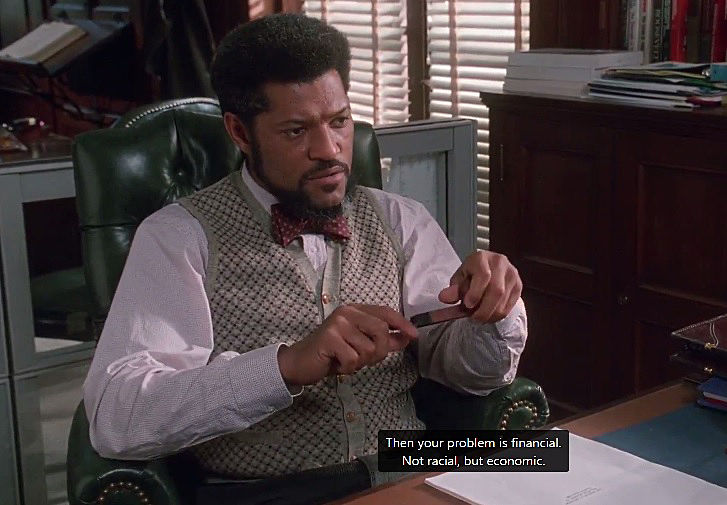
Screengrab from Higher Learning (1995), property of Columbia Pictures and Sony Pictures Releasing, fair use
Professor Phipps’ rational conclusion is where Ladies First and Higher Learning intersect, be it misogyny (hatred of, aversion to, or prejudice against women) or racism (a belief that race is a fundamental determinant of human traits and capacities and that racial differences produce an inherent superiority or inferiority of a particular race).
Arguably, the struggle for most people across the globe, let alone the U.S.—in which Higher Learning takes place, is one of class – not sex, gender, race, ethnicity, etc. About this matter, one source states:
In political science, the terms class struggle, class conflict, and class war refer to the economic antagonism and political tension that can exist between social classes because of clashing interests, competition for limited resources, and inequalities of power in a socioeconomic hierarchy.
Commonly cited historical examples of class antagonists are slavemasters and slaves, feudal lords and serfs, landowners and tenants, and capitalists and workers.
The writings of several leftist, socialist, and communist theorists portray class struggle as a core tenet and a practical means for effecting radical sociopolitical transformations for the majority working class. It is also a central concept within conflict theories of sociology and political philosophy.
Whereas my former disempowering perspective, related to Fudge’s outlook, regarded how my reaction to a class struggle was the fault of other people, I now empoweringly view matters according to Professor Phipps’ outlook, taking personal ownership for my own response.
I didn’t create the socioeconomic conditions which paved way for spooks like Steinem to ostensibly agitate sociopolitical tensions with a fruitless so-called battle of the sexes—whereby men and women proverbially fight one another instead of focusing on actual centers of power.
How clever the CIA has been at stirring an axiomatic pot of shit by keeping people distracted with petty skirmishers rather than directing their grievances at bankers, lobbyists, oligarchs, plutocrats, technocrats, politicians, and others who hold genuine reins of power! Ask Gabbard!
Firsthand, I’ve witnessed the Agency stirring shit in South America when I was assigned to diplomatic posts in Rio de Janeiro, Brasil and Lima, Peru. The same PSYOPs which were effective in those regions are manifest in the U.S. All the while, class struggle is largely ignored.
As long as female and male feminists self-disturb about me reminiscing over having fucked my girlfriend in 1995 – when minors supposedly aren’t capable of consenting to sexual intercourse – then who will focus on the rise of data centers? Distract, distract, distract! Stir that pot of shit!
As people bitch about reportedly “Elon Musk’s outrage at Christopher Nolan” for racial swapping in The Odyssey (2026), information from artificial intelligence (AI) is being stored in data centers. Have you paid any attention to how the U.S. and Israel has used AI aboard?
Target packages (i.e., kill lists) are compiled for those who pose threats to power centers, and are subsequently eliminated by autonomous weaponry (e.g., drones fitted with bombs). Meanwhile, people here in the U.S. will take issue with my use of the word “bitch” herein. Distract and stir!
If Higher Learning taught me anything, it’s that class struggle is the true problem – not frivolous distractions pioneered by PSYOPs. Fascinatingly, one of the final scenes in Higher Learning thusly appeals to the memory of social reformer, abolitionist, and statesman Frederick Douglass:
Malik: [following Deja’s murder by Remy, discussing his future plans with the educator] What do you think I should do?
Professor Phipps: What do I think?
Malik: You’re right. That’s my job. [personal ownership!!!] Man, I don’t know. Maybe if I hadn’t… it’s just… man, I don’t know what to do, man.
Professor Phipps: Mr. Williams, in spite of the recent tragedy here, you have persevered. And you have overcome a great many obstacles this semester. For those reasons, you have my utmost respect and every confidence that you will make a wise decision concerning your future. [reinforcement of personal ownership!!!]
Malik: I think… gotta get my head straight. I’ma go now.
Professor Phipps: Malik! [first time that Professor Phipps uses Malik’s first name, representing a perspective of equal footing] ‘Without struggle, there is no progress.’ [a reframe of Douglass’ quote, “If there is no struggle, there is no progress.”]
Malik: Frederick Douglass.
Professor Phipps: Right. Right.
Regarding mental health, accepting personal ownership of class struggle, one may reasonably anticipate or expect hardship in life. This is the helpful REBT practice of unconditional acceptance. It’s the antithesis of unhelpful collective ownership for one’s own struggles.
As Douglass comprehended, if there’s no struggle, then there’s no progress in this regard. Therefore, one can refrain from self-disturbance while instead settling for self-distress when facing discomfort – rather than pointing the finger at who’s to blame for one’s own reactions.
Conclusion
I originally planned on writing in detail about Ladies First herein. However, I concluded that the distraction of feminism is divisive. I don’t want to stir the shit! Does our nation truly need any more justification for citizens disempoweringly turning against one another? I don’t believe so.
Besides, feminism has benefited power centers by doubling government revenue (i.e., income from taxation). Adding women to the workforce, penalizing women for receiving government assistance when men are in the home, and fracturing families is what feminism wrought.
People who are fortunate enough to have jobs are getting fucked in the ass with no lube, as the government exploits the citizenry, performs PSYOPs on our population to pit us against one another, and sends our money aboard to fuck over other nations. Stir and distract, fuck in the ass!
My ass hurts, and I bet yours does, too! You aren’t my enemy, nor am I yours. Therefore, I instead decided to write about the empowering message of Higher Learning herein. Rather than one of division, it’s a unifying psychoeducational lesson.
Currently, many of us have an economic problem – not racial, ethnic, sex-based, gender-based, or otherwise. Our class struggle is evident. Just go to the store, stop by any gas station, glance at your energy bill, or even compare the cost of psychotherapy from different providers.
Getting fucked in the ass by the government is expensive! All the same, if you take personal ownership for your own reaction to a sore asshole, then you’ll lean more toward the helpful perspective of Professor Phipps, and less in the unhelpful direction of Fudge.
That is, as long as we maintain a functional society. Otherwise, the latter view may be needed in order to reverse course or bring about an altogether different system of socioeconomic existence – as we no longer have a Constitutional Republic – for which I’m not advocating herein.
Ultimately, if there is no struggle, there is no progress. So, I invite you to struggle in as healthy a manner as possible. No distractions. No blaming others for your condition. Simply accept personal ownership, and let’s get free of our self-imposed shackles! Are you with me?
If you’re looking for a provider who tries to work to help you understand how thinking impacts physical, mental, emotional, and behavioral elements of your life, I invite you to reach out today by using the contact widget on my website.
As the world’s foremost hip hop-influenced REBT psychotherapist, I’m pleased to try to help people with an assortment of issues from anger (hostility, rage, and aggression) to relational issues, adjustment matters, trauma experience, justice involvement, attention-deficit hyperactivity disorder, anxiety and depression, and other mood or personality-related matters.
At Hollings Therapy, LLC, serving all of Texas, I aim to treat clients with dignity and respect while offering a multi-lensed approach to the practice of psychotherapy and life coaching. My mission includes: Prioritizing the cognitive and emotive needs of clients, an overall reduction in client suffering, and supporting sustainable growth for the clients I serve. Rather than simply trying to help you to feel better, I want to try to help you get better!
Deric Hollings, LPC, LCSW
References:
APA Dictionary of Psychology. (2023, November 15). Prejudice. American Psychological Association. Retrieved from https://dictionary.apa.org/prejudice
APA Dictionary of Psychology. (2018, April 19). Propaganda. American Psychological Association. Retrieved from https://dictionary.apa.org/propaganda
Bazzi, M. (2026, May 24). Tulsi Gabbard’s resistance to foreign wars amid Trump’s aggression was her undoing. The Guardian. Retrieved from https://www.theguardian.com/commentisfree/2026/may/24/tulsi-gabbard-foreign-wars-trump
BlackPast. (2007, January 25). (1857) Frederick Douglass, “If there is no struggle, there is no progress”. Retrieved from https://blackpast.org/african-american-history/1857-frederick-douglass-if-there-no-struggle-there-no-progress/
Bud E Love. (2003, May 15). Bumping uglies. Urban Dictionary. Retrieved from https://www.urbandictionary.com/define.php?term=bumping+uglies
Dailey, B. (2006, September 22). Knocking boots. Urban Dictionary. Retrieved from https://www.urbandictionary.com/define.php?term=knocking%20boots
Emphinix. (n.d.). Higher Learning – Plot. IMDb. Retrieved from https://www.imdb.com/title/tt0113305/plotsummary/
Heineman, E. (2016, July/August). Review: Feminism and terrorism. The Women’s Review of Books. Retrieved from https://www.jstor.org/stable/26433312
Hollings, D. (2026, April 20). A cause for concern doesn’t cause concern. Hollings Therapy, LLC. Retrieved from https://www.hollingstherapy.com/post/a-cause-for-concern-doesn-t-cause-concern
Hollings, D. (2023, September 13). Acceptance. Hollings Therapy, LLC. Retrieved from https://www.hollingstherapy.com/post/acceptance
Hollings, D. (2024, November 15). Assumptions. Hollings Therapy, LLC. Retrieved from https://www.hollingstherapy.com/post/assumptions
Hollings, D. (2025, November 17). Bloodbending: A moral and ethical dilemma regarding control. Hollings Therapy, LLC. Retrieved from https://www.hollingstherapy.com/post/bloodbending-a-moral-and-ethical-dilemma-regarding-control
Hollings, D. (2024, May 27). Confusion. Hollings Therapy, LLC. Retrieved from https://www.hollingstherapy.com/post/confusion
Hollings, D. (2025, October 3). Control and influence: A soft center and coated in a candy shell. Hollings Therapy, LLC. Retrieved from https://www.hollingstherapy.com/post/control-and-influence-a-soft-center-and-coated-in-a-candy-shell
Hollings, D. (2024, October 27). Correlation does not imply causation. Hollings Therapy, LLC. Retrieved from https://www.hollingstherapy.com/post/correlation-does-not-imply-causation
Hollings, D. (2025, August 8). Cost vs. expense. Hollings Therapy, LLC. Retrieved from https://www.hollingstherapy.com/post/cost-vs-expense
Hollings, D. (2024, July 10). Costs and payoffs. Hollings Therapy, LLC. Retrieved from https://www.hollingstherapy.com/post/costs-and-payoffs
Hollings, D. (2024, September 14). Crazy. Hollings Therapy, LLC. Retrieved from https://www.hollingstherapy.com/post/crazy
Hollings, D. (2025, May 4). Dilemmas and paradoxes. Hollings Therapy, LLC. Retrieved from https://www.hollingstherapy.com/post/dilemmas-and-paradoxes
Hollings, D. (2022, March 15). Disclaimer. Hollings Therapy, LLC. Retrieved from https://www.hollingstherapy.com/post/disclaimer
Hollings, D. (2026, May 10). Discomfort anxiety: Where are you going? Hollings Therapy, LLC. Retrieved from https://www.hollingstherapy.com/post/discomfort-anxiety-where-are-you-going
Hollings, D. (2025, September 16). Dispute with respect. Hollings Therapy, LLC. Retrieved from https://www.hollingstherapy.com/post/dispute-with-respect
Hollings, D. (2025, March 12). Distress vs. disturbance. Hollings Therapy, LLC. Retrieved from https://www.hollingstherapy.com/post/distress-vs-disturbance
Hollings, D. (2026, May 23). Empowerment vs. disempowerment: Just doing it for the love of the game. Hollings Therapy, LLC. Retrieved from https://www.hollingstherapy.com/post/empowerment-vs-disempowerment-just-doing-it-for-the-love-of-the-game
Hollings, D. (2025, September 7). Everybody’s gotta learn sometime. Hollings Therapy, LLC. Retrieved from https://www.hollingstherapy.com/post/everybody-s-gotta-learn-sometime
Hollings, D. (2026, April 12). Excuses, explanations, and justifications. Hollings Therapy, LLC. Retrieved from https://www.hollingstherapy.com/post/excuses-explanations-and-justifications
Hollings, D. (2023, September 8). Fair use. Hollings Therapy, LLC. Retrieved from https://www.hollingstherapy.com/post/fair-use
Hollings, D. (2024, May 17). Feeling better vs. getting better. Hollings Therapy, LLC. Retrieved from https://www.hollingstherapy.com/post/feeling-better-vs-getting-better-1
Hollings, D. (2023, February 9). Feminism. Hollings Therapy, LLC. Retrieved from https://www.hollingstherapy.com/post/feminism
Hollings, D. (2023, October 12). Get better. Hollings Therapy, LLC. Retrieved from https://www.hollingstherapy.com/post/get-better
Hollings, D. (2026, March 2). Get out of your own way: Petty annoyances and minor obstacles. Hollings Therapy, LLC. Retrieved from https://www.hollingstherapy.com/post/get-out-of-your-own-way-petty-annoyances-and-minor-obstacles
Hollings, D. (2024, April 13). Goals. Hollings Therapy, LLC. Retrieved from https://www.hollingstherapy.com/post/goals
Hollings, D. (2025, June 15). Griping, whining, bitching, moaning, complaining, whinging, venting, etc. Hollings Therapy, LLC. Retrieved from https://www.hollingstherapy.com/post/ griping-whining-bitching-moaning-complaining-whinging,-venting-etc
Hollings, D. (2024, March 27). Healthy vs. unhealthy frustration. Hollings Therapy, LLC. Retrieved from https://www.hollingstherapy.com/post/healthy-vs-unhealthy-frustration
Hollings, D. (n.d.). Hollings Therapy, LLC [Official website]. Hollings Therapy, LLC. Retrieved from https://www.hollingstherapy.com/
Hollings, D. (2026, March 16). Hopeful anticipation vs. disturbing expectation. Hollings Therapy, LLC. Retrieved from https://www.hollingstherapy.com/post/hopeful-anticipation-vs-disturbing-expectation
Hollings, D. (2024, June 26). I ain’t trippin’. Hollings Therapy, LLC. Retrieved from https://www.hollingstherapy.com/post/i-ain-t-trippin
Hollings, D. (2024, January 22). IDK. Hollings Therapy, LLC. Retrieved from https://www.hollingstherapy.com/post/__idk
Hollings, D. (2025, October 4). Ignorance about the Americans. Hollings Therapy, LLC. Retrieved from https://www.hollingstherapy.com/post/ignorance-about-the-americas
Hollings, D. (2022, November 8). Information overload. Hollings Therapy, LLC. Retrieved from https://www.hollingstherapy.com/post/information-overload
Hollings, D. (2024, February 14). Insufferable vs. undesirable. Hollings Therapy, LLC. Retrieved from https://www.hollingstherapy.com/post/insufferable-vs-undesirable
Hollings, D. (2024, September 26). Interpreted reality. Hollings Therapy, LLC. Retrieved from https://www.hollingstherapy.com/post/interpreted-reality
Hollings, D. (2025, June 13). It isn’t manly to be enraged. Hollings Therapy, LLC. Retrieved from https://www.hollingstherapy.com/post/it-isn-t-manly-to-be-enraged
Hollings, D. (2025, October 13). Knowledge, wisdom, understanding. Hollings Therapy, LLC. Retrieved from https://www.hollingstherapy.com/post/knowledge-wisdom-understanding
Hollings, D. (2025, May 18). Learning to understand, attentively and deeply. Hollings Therapy, LLC. Retrieved from https://www.hollingstherapy.com/post/learning-to-understand-attentively-and-deeply
Hollings, D. (2023, September 19). Life coaching. Hollings Therapy, LLC. Retrieved from https://www.hollingstherapy.com/post/life-coaching
Hollings, D. (2026, May 17). Listening to reason through argument: Is the rhetoric of whataboutism persuasive? Hollings Therapy, LLC. Retrieved from https://www.hollingstherapy.com/post/listening-to-reason-through-argument-is-the-rhetoric-of-whataboutism-persuasive
Hollings, D. (2023, January 8). Logic and reason. Hollings Therapy, LLC. Retrieved from https://www.hollingstherapy.com/post/logic-and-reason
Hollings, D. (2025, May 25). Making the crooked straight. Hollings Therapy, LLC. Retrieved from https://www.hollingstherapy.com/post/making-the-crooked-straight
Hollings, D. (2024, March 4). Mental, emotional, and behavioral health. Hollings Therapy, LLC. Retrieved from https://www.hollingstherapy.com/post/mental-emotional-and-behavioral-health
Hollings, D. (2025, November 16). Mental health, mental illness, and mental disorder. Hollings Therapy, LLC. Retrieved from https://www.hollingstherapy.com/post/mental-health-mental-illness-and-mental-disorder
Hollings, D. (2026, February 16). Moral panic: The irrationality of slogans such as “believe women” and “believe victims”. Hollings Therapy, LLC. Retrieved from https://www.hollingstherapy.com/post/moral-panic-the-irrationality-of-slogans-such-as-believe-women-and-believe-victims
Hollings, D. (2024, September 27). My attitude. Hollings Therapy, LLC. Retrieved from https://www.hollingstherapy.com/post/my-attitude
Hollings, D. (2024, May 30). Nobody’s perfect. Hollings Therapy, LLC. Retrieved from https://www.hollingstherapy.com/post/nobody-s-perfect
Hollings, D. (2023, September 3). On feelings. Hollings Therapy, LLC. Retrieved from https://www.hollingstherapy.com/post/on-feelings
Hollings, D. (2023, April 24). On truth. Hollings Therapy, LLC. Retrieved from https://www.hollingstherapy.com/post/on-truth
Hollings, D. (2025, September 15). One of life’s little inconveniences. Hollings Therapy, LLC. Retrieved from https://www.hollingstherapy.com/post/one-of-life-s-little-inconveniences
Hollings, D. (2024, November 18). Opinions. Hollings Therapy, LLC. Retrieved from https://www.hollingstherapy.com/post/opinions
Hollings, D. (2026, April 19). Outcome: Victim mentality and playing the victim. Hollings Therapy, LLC. Retrieved from https://www.hollingstherapy.com/post/outcome-victim-mentality-and-playing-the-victim
Hollings, D. (2026, April 20). Overconfidence: To thine own self be true. Hollings Therapy, LLC. Retrieved from https://www.hollingstherapy.com/post/overconfidence-to-thine-own-self-be-true
Hollings, D. (2026, May 15). Owning up to personal and collective codes of conduct. Hollings Therapy, LLC. Retrieved from https://www.hollingstherapy.com/post/owning-up-to-personal-and-collective-codes-of-conduct
Hollings, D. (2025, April 9). Perception, action, and will. Hollings Therapy, LLC. Retrieved from https://www.hollingstherapy.com/post/perception-action-and-will
Hollings, D. (2026, April 12). Perseverance and persistence: What does not kill me makes me stronger. Hollings Therapy, LLC. Retrieved from https://www.hollingstherapy.com/post/perseverance-and-persistence-what-does-not-kill-me-makes-me-stronger
Hollings, D. (2022, November 7). Personal ownership. Hollings Therapy, LLC. Retrieved from https://www.hollingstherapy.com/post/personal-ownership
Hollings, D. (2025, September 9). Personal responsibility and accountability. Hollings Therapy, LLC. Retrieved from https://www.hollingstherapy.com/post/personal-responsibility-and-accountability
Hollings, D. (2026, April 13). PLUR: Addressing sexual assault and rape. Hollings Therapy, LLC. Retrieved from https://www.hollingstherapy.com/post/plur-addressing-sexual-assault-and-rape
Hollings, D. (2026, May 9). Political violence: Freedom’s got a shotgun. Hollings Therapy, LLC. Retrieved from https://www.hollingstherapy.com/post/political-violence-freedom-s-got-a-shotgun
Hollings, D. (2025, September 19). Power. Hollings Therapy, LLC. Retrieved from https://www.hollingstherapy.com/post/power
Hollings, D. (2026, March 18). Prejudice vs. discernment: Bias. Hollings Therapy, LLC. Retrieved from https://www.hollingstherapy.com/post/prejudice-vs-discernment-bias
Hollings, D. (2023, November 23). Problems. Hollings Therapy, LLC. Retrieved from https://www.hollingstherapy.com/post/problems
Hollings, D. (2026, March 8). Propaganda: War Machine. Hollings Therapy, LLC. Retrieved from https://www.hollingstherapy.com/post/propaganda-war-machine
Hollings, D. (2024, January 1). Psychoeducation. Hollings Therapy, LLC. Retrieved from https://www.hollingstherapy.com/post/psychoeducation
Hollings, D. (2024, May 5). Psychotherapist. Hollings Therapy, LLC. Retrieved from https://www.hollingstherapy.com/post/psychotherapist
Hollings, D. (2022, March 24). Rational emotive behavior therapy (REBT). Hollings Therapy, LLC. Retrieved from https://www.hollingstherapy.com/post/rational-emotive-behavior-therapy-rebt
Hollings, D. (2025, August 13). Rational versus irrational thoughts and beliefs. Hollings Therapy, LLC. Retrieved from https://www.hollingstherapy.com/post/rational-versus-irrational-thoughts-and-beliefs
Hollings, D. (2024, January 1). Rational vs. irrational. Hollings Therapy, LLC. Retrieved from https://www.hollingstherapy.com/post/rational-vs-irrational
Hollings, D. (2024, December 5). Reasoning. Hollings Therapy, LLC. Retrieved from https://www.hollingstherapy.com/post/reasoning
Hollings, D. (2024, July 10). Recommendatory should beliefs. Hollings Therapy, LLC. Retrieved from https://www.hollingstherapy.com/post/recommendatory-should-beliefs
Hollings, D. (2025, February 24). Reinforcement and punishment. Hollings Therapy, LLC. Retrieved from https://www.hollingstherapy.com/post/reinforcement-and-punishment
Hollings, D. (2026, April 13). Shackled and miserable. Hollings Therapy, LLC. Retrieved from https://www.hollingstherapy.com/post/shackled-and-miserable
Hollings, D. (2025, December 24). Some people advocate walking. Hollings Therapy, LLC. Retrieved from https://www.hollingstherapy.com/post/some-people-advocate-walking
Hollings, D. (2025, January 5). Spooky business. Hollings Therapy, LLC. Retrieved from https://www.hollingstherapy.com/post/spooky-business
Hollings, D. (2024, February 27). Suffering, struggling, and battling vs. experiencing. Hollings Therapy, LLC. Retrieved from https://www.hollingstherapy.com/post/suffering-struggling-and-battling-vs-experiencing
Hollings, D. (2025, October 22). The construct. Hollings Therapy, LLC. Retrieved from https://www.hollingstherapy.com/post/the-construct
Hollings, D. (2026, March 24). The house negro and the field negro: Suffer peacefully. Hollings Therapy, LLC. Retrieved from https://www.hollingstherapy.com/post/the-house-negro-and-the-field-negro-suffer-peacefully
Hollings, D. (2026, April 23). The three traditionally identified components of the mind: Affect, cognition, and conation. Hollings Therapy, LLC. Retrieved from https://www.hollingstherapy.com/post/ the-three-traditionally-identified-components-of-the-mind-affect-cognition-and-conation
Hollings, D. (2025, April 15). This cake smells unpleasant. Hollings Therapy, LLC. Retrieved from https://www.hollingstherapy.com/post/this-cake-smells-unpleasant
Hollings, D. (2025, February 28). To try is my goal. Hollings Therapy, LLC. Retrieved from https://www.hollingstherapy.com/post/to-try-is-my-goal
Hollings, D. (2025, April 18). Tolerable FAD. Hollings Therapy, LLC. Retrieved from https://www.hollingstherapy.com/post/tolerable-fad
Hollings, D. (2025, January 9). Traditional ABC model. Hollings Therapy, LLC. Retrieved from https://www.hollingstherapy.com/post/traditional-abc-model
Hollings, D. (2026, March 14). Trolley problem: Distress or disturbance. Hollings Therapy, LLC. Retrieved from https://www.hollingstherapy.com/post/trolley-problem-distress-or-disturbance
Hollings, D. (2024, October 20). Unconditional acceptance redux. Hollings Therapy, LLC. Retrieved from https://www.hollingstherapy.com/post/unconditional-acceptance-redux
Hollings, D. (2024, October 26). Unhelpful expectations. Hollings Therapy, LLC. Retrieved from https://www.hollingstherapy.com/post/unhelpful-expectations
Hollings, D. (2023, October 10). When others don’t share your worldview. Hollings Therapy, LLC. Retrieved from https://www.hollingstherapy.com/post/when-others-don-t-share-your-worldview
Hollings, D. (2025, January 10). Who is the one to blame? Hollings Therapy, LLC. Retrieved from https://www.hollingstherapy.com/post/who-is-the-one-to-blame
Hollings, D. (2026, April 30). Willfully stuck: I’m stuck in my ways. Hollings Therapy, LLC. Retrieved from https://www.hollingstherapy.com/post/willfully-stuck-i-m-stuck-in-my-ways
Keyshaw. (2004, October 7). Fall off. Urban Dictionary. Retrieved from https://www.urbandictionary.com/define.php?term=fall%20off
Kokozian Law Firm. (n.d.). Sexual harassment by persistent leering or staring. Retrieved from https://www.losangelesemployeelawyer.com/practice-areas/sexual-harassment-claims/sexual-harassment-by-persistent-leering-or-staring/
Kounalakis, M. (2015, October 29). The feminist was a spy. USC Center of Public Diplomacy. Retrieved from https://uscpublicdiplomacy.org/blog/feminist-was-spy
KyperVEVO. (2017, May 18). Kyper - Tic Tac Toe [Video]. YouTube. Retrieved from https://youtu.be/kREQJCEfGIY?si=vYOnSo7lLgfDd5pM
National Women’s History Museum. (n.d.). Gloria Steinem. Retrieved from https://www.womenshistory.org/education-resources/biographies/gloria-steinem
RaphaelSaadiqMusic. (2013, October 31). Raphael Saadiq - Ask of You (Official HD video) [Video]. YouTube. Retrieved from https://youtu.be/5IPvVg7zZmg?si=ig81y83Ama-zK_1N
Rep. Doug Lamborn. (2023, June 8). Welcome & congratulations to LTC Tulsi Gabbard, who recently assumed command of the @440thCA_BN - the newest battalion in the US Spec Ops & Psy Ops Command (Airborne). I wish outgoing commander LTC Matthew Daly & family well in their next endeavor & thank him for his leadership [post]. X. Retrieved from https://x.com/RepDLamborn/status/1666876057725567003?mx=2
Sotheby’s. (n.d.). LL Cool J: “Rush artist management presents LL Cool J Nitro World Tour” concert poster, 1989. Retrieved from https://www.sothebys.com/en/buy/auction/2020/hip-hop/ll-cool-j-rush-artist-management-presents-ll-cool
Tropedia. (n.d.). But wait! There’s more! Fandom. Retrieved from https://tropedia.fandom.com/wiki/But_Wait!_There%27s_More!
Wikipedia. (n.d.). Artificial intelligence. Retrieved from https://en.wikipedia.org/wiki/Artificial_intelligence
Wikipedia. (n.d.). Battle of the sexes. Retrieved from https://en.wikipedia.org/wiki/Battle_of_the_Sexes
Wikipedia. (n.d.). Central Intelligence Agency. Retrieved from https://en.wikipedia.org/wiki/Central_Intelligence_Agency
Wikipedia. (n.d.). Christopher Nolan. Retrieved from https://en.wikipedia.org/wiki/Christopher_Nolan
Wikipedia. (n.d.). Class struggle. Retrieved from https://en.wikipedia.org/wiki/Class_struggle
Wikipedia. (n.d.). Cole Hauser. Retrieved from https://en.wikipedia.org/wiki/Cole_Hauser
Wikipedia. (n.d.). Contemporary R&B. Retrieved from https://en.wikipedia.org/wiki/Contemporary_R%26B
Wikipedia. (n.d.). Data center. Retrieved from https://en.wikipedia.org/wiki/Data_center
Wikipedia. (n.d.). Elon Musk. Retrieved from https://en.wikipedia.org/wiki/Elon_Musk
Wikipedia. (n.d.). Frederick Douglass. Retrieved from https://en.wikipedia.org/wiki/Frederick_Douglass
Wikipedia. (n.d.). Gloria Steinem. Retrieved from https://en.wikipedia.org/wiki/Gloria_Steinem
Wikipedia. (n.d.). Gloria Steinem – CIA ties and leader of Independent Research Service. Retrieved from https://en.wikipedia.org/wiki/Gloria_Steinem#CIA_ties_and_leader_of_Independent_Research_Service
Wikipedia. (n.d.). Higher Learning. Retrieved from https://en.wikipedia.org/wiki/Higher_Learning
Wikipedia. (n.d.). Higher Learning (soundtrack). Retrieved from https://en.wikipedia.org/wiki/Higher_Learning_(soundtrack)
Wikipedia. (n.d.). Ice Cube. Retrieved from https://en.wikipedia.org/wiki/Ice_Cube
Wikipedia. (n.d.) Jay R. Ferguson. Retrieved from https://en.wikipedia.org/wiki/Jay_R._Ferguson
Wikipedia. (n.d.). Jennifer Connelly. Retrieved from https://en.wikipedia.org/wiki/Jennifer_Connelly
Wikipedia. (n.d.). Kristy Swanson. Retrieved from https://en.wikipedia.org/wiki/Kristy_Swanson
Wikipedia. (n.d.). Kyper. Retrieved from https://en.wikipedia.org/wiki/Kyper
Wikipedia. (n.d.). Ladies First (2026 film). Retrieved from https://en.wikipedia.org/wiki/Ladies_First_(2026_film)
Wikipedia. (n.d.). Laurence Fishburne. Retrieved from https://en.wikipedia.org/wiki/Laurence_Fishburne
Wikipedia. (n.d.). Marine Security Guard. Retrieved from https://en.wikipedia.org/wiki/Marine_Security_Guard
Wikipedia. (n.d.). Michael Rapaport. Retrieved from https://en.wikipedia.org/wiki/Michael_Rapaport
Wikipedia. (n.d.). N.W.A. Retrieved from https://en.wikipedia.org/wiki/N.W.A
Wikipedia. (n.d.). Omar Epps. Retrieved from https://en.wikipedia.org/wiki/Omar_Epps
Wikipedia. (n.d.). Psychological operations (United States). Retrieved from https://en.wikipedia.org/wiki/Psychological_operations_(United_States)
Wikipedia. (n.d.). Raphael Saadiq. Retrieved from https://en.wikipedia.org/wiki/Raphael_Saadiq
Wikipedia. (n.d.). The Odyssey (2026 film). Retrieved from https://en.wikipedia.org/wiki/The_Odyssey_(2026_film)
Wikipedia. (n.d.). Tulsi Gabbard. Retrieved from https://en.wikipedia.org/wiki/Tulsi_Gabbard
Wikipedia. (n.d.). Tyra Banks. Retrieved from https://en.wikipedia.org/wiki/Tyra_Banks
Wikipedia. (n.d.). War of the Worlds (2025 film). Retrieved from https://en.wikipedia.org/wiki/War_of_the_Worlds_(2025_film)
Wikipedia. (n.d.). White power skinhead. Retrieved from https://en.wikipedia.org/wiki/White_power_skinhead
Williams, T. C. (2026, May 23). The absurd misunderstanding fueling the debate over The Odyssey. The Atlantic. Retrieved from https://www.theatlantic.com/ideas/2026/05/the-odyssey-musk-nolan-nyongo/687288/


